garage door repair Mesa

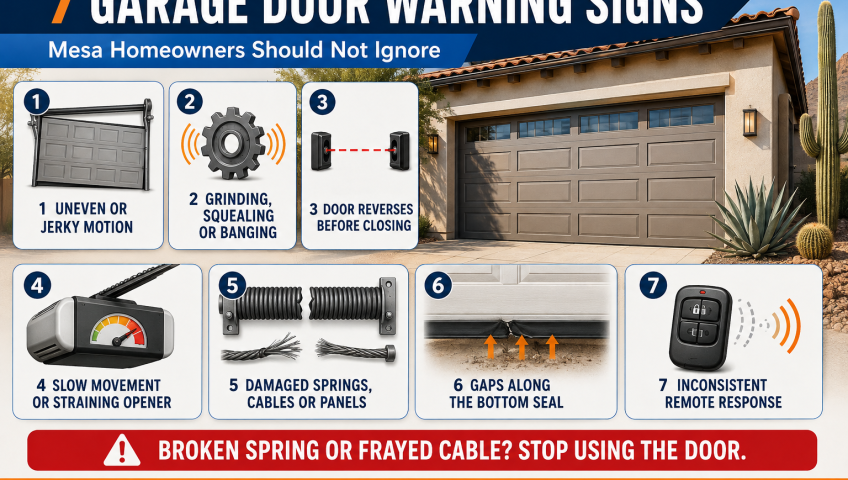
Garage Door Repair in Mesa: 7 Warning Signs You Should Not Ignore

Garage door repair in Mesa should be scheduled when a door jerks, hangs unevenly, makes new grinding or banging sounds, reverses unexpectedly, moves slowly, shows damaged cables or springs, or comes out of its tracks. Stop operating it if a spring or cable is broken, the door is crooked, a roller has left the track, or the door could fall.

You can safely observe the door from a distance and clear debris from the photo-eye area. Do not touch or adjust springs, cables, drums, bottom brackets, or a displaced door. Those parts manage significant weight and stored tension.

Which Garage Door Warning Signs Require Immediate Attention?

Garage Door Warning Signs: What to Do Next
What you observe Safe response Urgency
Broken spring, loose cable, crooked door, or roller outside the track Keep clear and stop operating the door Immediate technician inspection
Door reverses, will not close, or safety sensor fails Clear the opening; inspect sensor area without rewiring Do not bypass the safety system
New squeal, vibration, slow travel, or worn rollers Observe one cycle from a safe distance Arrange service before the symptom worsens
⚠️ Note: Never stand under a malfunctioning door or attempt to restrain it by hand. Keep children, pets, and vehicles outside its path.

1. The Door Moves Unevenly, Jerks, or Hangs Crooked

A sectional garage door should travel smoothly while remaining level. A door that rises higher on one side, shudders, or pauses may have a cable problem, worn roller, bent track, loose hinge, or uneven spring force.

Watch from inside the garage while staying well away from the tracks. Do not place a hand near a roller or hinge. If the bottom edge is visibly tilted, stop. A cable may have lost tension or slipped at the drum, and another cycle can pull a roller out of the track.

Professional residential garage door repair in Mesa should include the whole counterbalance system, not just the visible crooked section. Correcting only the track may leave the actual spring or cable fault unresolved.

2. Grinding, Squealing, Scraping, or Banging Is New

A new sound is useful diagnostic evidence. Grinding can point to a worn roller, damaged bearing, or opener gear. Scraping may mean a panel, track, or cable is contacting a surface. A sharp bang can occur when a torsion spring breaks.

Do not assume every sound needs more lubricant. Applying the wrong product can collect desert dust and create abrasive buildup. Lubrication also cannot straighten a bent track, replace a cracked hinge, or restore a failing bearing.

Record the sound from a safe location and note whether it happens while opening, closing, or both. That information helps a technician isolate the load-related component without repeated test cycles.

3. The Door Is Slow, Heavy, or Stops Mid-Travel

A door that has become slow or unusually heavy may no longer be properly counterbalanced. The opener is designed to guide a balanced door; it should not compensate for a weakened or broken spring.

Heat can affect lubricants, seals, metal clearances, and opener electronics in a Mesa garage. However, high temperature alone does not prove the cause. A technician should distinguish heat-related behavior from spring fatigue, roller drag, binding tracks, incorrect travel limits, or a worn motor component.

If the opener strains, hums without moving the door, or the rail flexes, stop using it. Request an inspection that includes the door balance and the appropriate garage door spring service.

4. The Door Reverses Unexpectedly or Will Not Close

Unexpected reversal can indicate an obstruction, misaligned photo-eye sensors, wiring trouble, excessive resistance, or incorrect opener travel and force settings. Safety reversal is not a feature to bypass.

The U.S. Consumer Product Safety Commission advises testing the opener’s reversing feature monthly and having the system inspected if it fails to reverse as intended. See the CPSC garage door opener safety guidance.

You may remove an object from the opening and gently wipe dust from the photo-eye lenses with a soft, dry cloth. Do not tape sensors together, hold down the wall control to defeat protection, alter wiring, or increase the force setting to push through resistance.

5. A Spring, Cable, Drum, or Bottom Bracket Looks Damaged

Visible damage in the counterbalance system is a stop-use condition. Common clues include a gap in a torsion spring, a hanging lift cable, cable strands near the bottom bracket, or a cable that is no longer seated on its drum.

These components can store tension even when the door is closed. The door itself may also be far heavier than expected when spring assistance is lost. Do not loosen fasteners, cut a cable, wind a spring, or remove the bottom bracket.

Keep the opening clear and arrange professional spring and cable repair. If the door is open, do not walk beneath it or try to pull it down by hand.

6. Rollers Are Leaving the Track or the Track Is Bent

A roller outside the track means the door is no longer fully guided. A bent vertical or horizontal track, loose mounting bracket, cable imbalance, impact, or failed roller can produce this condition.

Do not hammer the track back into place while the door is loaded. Do not pry a roller into the track or disconnect the opener to move a crooked door manually. The door can shift suddenly and damage panels, hinges, cables, or nearby property.

A proper garage door track adjustment checks spacing, alignment, fasteners, roller condition, cable position, and door balance. Track correction without identifying why it moved may lead to the same failure again.

7. The Opener Hums, Clicks, or Operates Inconsistently

An opener that hums, clicks, loses remote response, or stops at the same point may have a power, logic board, capacitor, gear, trolley, rail, limit-setting, sensor, or door-balance problem.

Start with safe observations: confirm the garage has power, replace the remote battery if appropriate, and note the opener’s indicator lights. Do not open the motor housing or touch wiring unless the circuit has been made safe and you are qualified to perform electrical work.

The opener and door must be diagnosed as one system. Professional garage door opener repair should rule out a binding or unbalanced door before treating the motor as the only fault.

What Can a Homeowner Safely Check Before Calling?

A homeowner can perform a limited visual check without touching loaded hardware or entering the door’s path. The goal is to document symptoms, not complete a repair.

  1. Clear the area. Move people, pets, and vehicles away from the opening. Do not stand under the door.
  2. Look before operating. Check for a spring gap, hanging cable, crooked bottom edge, displaced roller, bent track, loose panel, or object in the opening.
  3. Stop if structural hardware looks wrong. Do not run a test cycle when a spring, cable, track, roller, hinge, or bracket appears damaged.
  4. Observe one cycle only if the system looks intact. Stand back and note the location of noise, hesitation, reversal, vibration, or uneven travel.
  5. Document the result. Take photos from a safe distance and record the opener model, indicator lights, recent impact, power outage, or storm exposure.

A manual balance test is often useful to a technician, but it requires disconnecting the opener and controlling the door by hand. Skip that test if the door is heavy, crooked, damaged, off-track, or has a suspected spring or cable problem.

When Should You Stop Operating the Garage Door?

Stop using the garage door whenever another cycle could allow it to fall, leave the tracks, increase cable tension, or defeat an entrapment-protection feature.

  • A torsion spring has a visible gap or an extension spring is broken.
  • A lift cable is frayed, slack, hanging, or off its drum.
  • The door is crooked, jammed, or partly outside a track.
  • A roller is displaced or a track is severely bent or detached.
  • The door drops, accelerates downward, or will not remain controlled.
  • The opener rail flexes or the motor strains against a stuck door.
  • The safety-reversal system does not work as intended.
  • A panel or hinge is separating and could affect door stability.

Do not park beneath a suspended door or use locking pliers as a substitute for a repair. If a vehicle is trapped inside, tell the technician when scheduling service. That context helps the company understand access needs without encouraging a risky release.

How Mesa Heat, Dust, and Monsoon Conditions Affect Diagnosis

Mesa’s desert environment can accelerate some forms of wear, but climate should be treated as context rather than an automatic diagnosis. Direct sun can heat dark door panels and contribute to thermal movement. Dust can collect at tracks, rollers, sensor lenses, seals, and lubricated surfaces.

During monsoon season, wind-driven debris, moisture, and brief power disruptions may produce new symptoms. A photo-eye may become dirty or misaligned. A seal may harden or separate. An opener may need electrical diagnosis after inconsistent power.

These factors can overlap with ordinary cycle wear. For example, wiping a dusty sensor lens may solve a closure problem, but it will not correct a door that reverses because a track is binding. Likewise, adding lubricant cannot restore spring force or repair a damaged opener gear.

How a Technician Separates the Symptom From the Cause

A technician should inspect the complete door system because one symptom can have several causes. A slow door may involve spring balance, roller resistance, track alignment, opener force, travel limits, or more than one condition.

The inspection normally follows the load path: panels and hinges, rollers and tracks, springs, cables and drums, then the opener rail, trolley, controls, photo-eyes, and safety reversal. Measurements and manufacturer specifications matter more than guessing from sound alone.

Here are two technical examples, not claims about completed customer jobs:

Example A: A door rises several inches and stops while the opener strains. A broken spring or loss of counterbalance may be loading the opener beyond normal operation. The safe response is to stop cycling the door and inspect the spring system before considering motor work.

Example B: A door closes most of the way, reverses, and shows no visible obstruction. Dusty sensors are one possibility, but track resistance, a damaged roller, travel settings, or safety-system trouble may also be involved. Cleaning the sensor area is reasonable; bypassing it is not.

Repair or Replace: What Should Guide the Decision?

Repair is usually reasonable when the door structure is sound and the fault is limited to serviceable hardware, alignment, sensors, controls, or opener components. Replacement deserves consideration when damage affects several sections, the door cannot be made stable, or compatible parts and safe operation are uncertain.

Do not make the decision from age alone. Review panel condition, track geometry, spring and cable condition, opener safety features, repair history, parts availability, and the cost of correcting all related faults. A clear estimate should separate the immediate safety repair from optional upgrades.

Prices are not included here because the correct scope depends on door size, weight, spring system, hardware, opener model, access, and damage. A quote made without identifying those variables can be misleading.

Homeowner Checklist Before Scheduling Garage Door Repair in Mesa

Share concise observations with the service provider while avoiding any hands-on inspection of loaded parts.

  • Is the door open, closed, or stuck between positions?
  • Is the bottom edge level?
  • Do you see a spring gap, loose cable, displaced roller, or bent track?
  • Does the symptom occur while opening, closing, or both?
  • What sound occurs, and where does it seem to originate?
  • Do the opener and photo-eye indicator lights show a pattern?
  • Was there a recent impact, outage, dust storm, or monsoon event?
  • Is a vehicle trapped inside, and is another entrance available?

Frequently Asked Questions — Garage Door Repair in Mesa

Can I use my garage door if one spring is broken? +

No. Stop operating the door and keep clear of it. The opener is not a substitute for the missing counterbalance force, and another cycle can overload the motor or affect cables and tracks. Do not attempt to lift the door or wind the spring yourself.

Why does my garage door close and then reopen? +

The opener may be detecting an obstruction, sensor problem, excessive door resistance, or an incorrect travel setting. Clear the opening and gently clean the photo-eye lenses. If reversal continues, stop repeated testing and request diagnosis. Never bypass the sensors or increase force to overcome binding.

Is a noisy garage door always dangerous? +

Not every sound means immediate danger, but a new bang, scrape, grind, or repeated pop should be investigated. Stop operating the door if the noise appears with crooked travel, a loose cable, a spring gap, a displaced roller, or sudden dropping. Record the sound from a safe distance.

Can I put a garage door roller back into the track? +

Do not pry a roller back into place while the door is loaded. A displaced roller can be the result of track movement, cable imbalance, impact, or failed hardware. Manipulating it can make the door shift suddenly. Keep clear and have the complete track and counterbalance system inspected.

Does Mesa heat damage garage door openers? +

High garage temperatures can contribute to stress on electronics, lubricants, seals, and materials, but heat is not a complete diagnosis. A technician should also check door balance, rollers, tracks, travel limits, sensors, power, and opener components before deciding which part requires repair.

What information should I provide when requesting service? +

Explain whether the door is open, closed, crooked, or stuck. Mention visible spring, cable, roller, track, panel, or sensor issues and any recent impact or outage. Share the opener model and photos taken from a safe distance. State if a vehicle is trapped inside.

How often should I test the garage door safety reversal? +

The CPSC advises consumers to test the opener’s reversing feature monthly according to the manufacturer’s instructions. If the system does not reverse correctly, stop relying on automatic operation and arrange professional inspection. Do not adjust or bypass a safety feature without following the correct manufacturer procedure.

Schedule Garage Door Repair in Mesa Before the Damage Spreads

If your door shows one of these warning signs, the next step is a controlled inspection—not another series of test cycles. For garage door repair in Mesa, call Discount Garage Door Repair at (480) 531-7181 and describe what you can see from a safe distance.

You can also review our verified Google Business Profile for location and business information. Keep the door’s path clear until a technician confirms that the springs, cables, tracks, rollers, opener, and safety system can operate correctly.
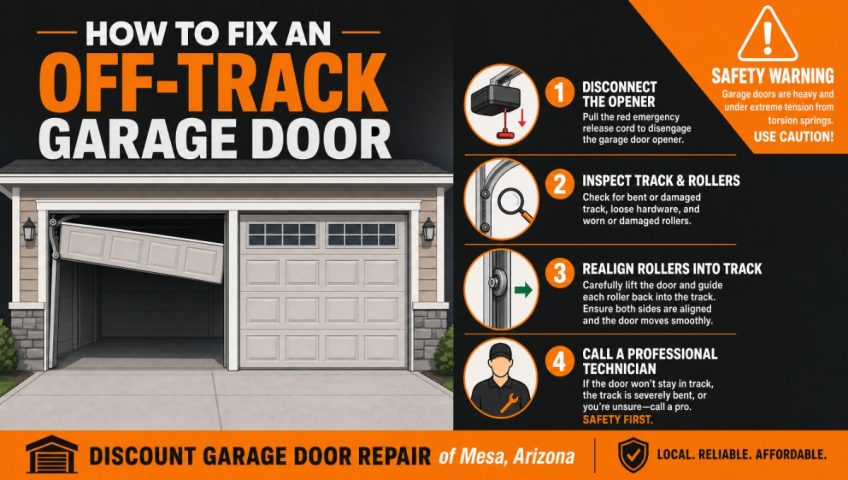
Off-Track Garage Door? How to Fix It Safely and Restore Your Home in Mesa, AZ

That sudden grinding noise, the panel hanging at an angle, the door frozen halfway up the opening — an off-track garage door turns an everyday convenience into a security risk and a safety hazard in seconds. The good news is that the cause is almost always identifiable, and many situations can be stabilized quickly while a lasting fix is arranged. Below, our team walks you through exactly why doors jump their tracks, what you can safely check yourself, and the moment professional help becomes non-negotiable. Keep reading and you will know precisely what to do next.

We are Discount Garage Door Repair of Mesa Arizona, and over our years serving Valley homeowners we have realigned, rebuilt, and replaced thousands of residential doors. We have written this guide the way we would explain it standing in your driveway: clearly, honestly, and with your safety first.

Why an Off-Track Garage Door Happens (and What It Means for Your Home)

An off-track garage door occurs when one or more rollers slip out of the vertical or horizontal metal tracks that guide the door’s travel. Once a roller leaves its channel, the door’s weight — often 150 pounds or more — becomes unevenly distributed, which is why the panel sags, twists, or jams. Understanding the root cause matters, because a door that derailed from a worn roller needs a very different repair than one knocked loose by a vehicle bumper.

In our experience across Mesa neighborhoods, the most common triggers fall into a handful of categories:

  • Broken or worn rollers: Nylon and steel rollers wear out, seize, or shatter, allowing the door to drift out of alignment.
  • Bent or damaged tracks: A minor impact, a loose lag bolt, or years of vibration can warp the track just enough for a roller to escape.
  • Vehicle or object impact: A bump from a car bumper or a stored item is one of the most frequent causes we see on service calls.
  • Loose or failed hardware: Brackets, hinges, and fasteners loosen over time, especially under Arizona’s heat-and-cool daily cycle.
  • Broken cables or spring issues: When a lift cable snaps or a torsion spring fails, the door can drop and pull rollers out of the track instantly.
  • Dirty or obstructed tracks: Dust, debris, and dried grime build up in the channel and force rollers off course.

Whatever the trigger, a derailed door is more than an inconvenience. It compromises home security, undermines your curb appeal, and — most importantly — puts anyone standing nearby at risk if the panel shifts unexpectedly. If you are unsure what you are dealing with, our Mesa garage door specialists are a phone call away.

Quick Diagnosis: What’s Wrong and What to Do

Warning Sign Likely Cause DIY-Friendly? Recommended Action
Door hangs crooked, one side lower Roller out of track or bent track Sometimes Stop using the opener; inspect rollers
Loud bang, then door dropped Broken torsion spring or cable No Call a professional immediately
Grinding or scraping while moving Worn rollers or dry track Yes Clean and lubricate; replace rollers
Door stuck partway, won’t move Roller jammed off-track Caution Disconnect opener; do not force it
Visible gap between door and wall Track pulled from frame No Schedule professional realignment
Door reverses or won’t seal Misalignment or sensor fault Sometimes Check sensors; inspect track
Frayed or hanging cable Cable wear or drum slippage No Stop use; call a technician
Door jumps at the same spot Dented track section Caution Inspect and reshape or replace track

How to Fix an Off-Track Garage Door: Step by Step

Before touching anything, set expectations honestly: realigning a roller is sometimes a manageable task, but anything involving springs, cables, or a door under tension belongs to a trained technician. With that boundary clear, here is the process our installers follow, adapted for a homeowner’s safe first response.

Step 1 — Stop and Disconnect the Opener

Never operate the motor on a derailed door; forcing it can bend the track, snap a cable, or damage the opener itself. Pull the red emergency release cord so the door is in manual mode. This single step prevents the majority of secondary damage we are called to repair. If you are unsure how your unit disengages, our support team in Mesa can talk you through it.

Step 2 — Inspect the Track and Rollers

With the opener disengaged, look closely at where the roller left the track. Check for a bent rail, a flattened section, or a roller that is cracked or seized. A flashlight and a few minutes of careful observation tell you most of what you need to know. Note which side is affected and whether the damage looks like a clean derail or a deformed track — that distinction guides every garage door repair in Mesa we perform.

Step 3 — Secure the Door

If the door is partially open, use locking pliers clamped to the track below a roller, or have a second person steady the panel. A door that is off balance can move on its own. This is the point where many homeowners wisely decide to call us instead of going further, and we always respect that judgment.

Step 4 — Realign the Roller (Light Cases Only)

For a simple derail with no spring or cable involvement, you can sometimes open the track lip slightly with pliers, guide the roller back into the channel, and gently tap the track back into shape. Then re-seat the roller and confirm smooth movement by hand before reconnecting power. If the roller resists, the track is bent, or the door feels heavy or jerky, stop — this has crossed into professional territory, and our Mesa technicians are equipped to finish it correctly.

Step 5 — Test, Lubricate, and Reconnect

Once the roller is seated, lift and lower the door manually two or three times. It should glide without binding. Apply a garage-door-rated lubricant to rollers, hinges, and the track, then reconnect the opener and run one full cycle while watching closely. If anything looks off, disconnect again and reach out to our repair team.

⚠️ Safety Warning: Read Before You Touch the Springs

A garage door’s torsion springs and cables store enormous mechanical energy — enough to cause serious injury or worse if they release suddenly. Never attempt to loosen, adjust, or remove a spring, cable, or bottom bracket yourself. The same caution applies to the electrical components of your opener. If your off-track garage door involves a broken spring, a snapped cable, or any tension-loaded part, stop immediately and call a trained professional. No repair is worth a trip to the emergency room.

Off-Track Garage Door: DIY vs. Professional Repair

Homeowners often ask whether they should attempt the fix or call us. The honest answer depends on the cause and your comfort level. A roller that slipped out cleanly is reasonable to tackle; a spring, cable, or bent-track problem is not. We believe in transparency, so here is how we frame the decision for our customers, and you can always confirm with our Mesa service team.

  • Choose DIY when: the door is fully down and balanced, a single roller has clearly derailed, no spring or cable is involved, and you have the right tools and a helper.
  • Choose a professional when: a spring or cable is broken, the track is bent, the door is stuck under tension, multiple rollers are off, or you simply want it done safely the first time.

Our trucks arrive stocked with rollers, tracks, hinges, cables, and springs compatible with the major brands homeowners rely on — including LiftMaster, Chamberlain, and Genie openers — so most repairs are completed in a single visit. When you book through our Mesa garage door company, you also get a technician who inspects the whole system, not just the obvious symptom.

How We Repair Off-Track Doors the Right Way

What separates a lasting repair from a temporary patch is method and experience. Every technician on our team is trained on residential and commercial systems, follows established safety standards, and works to the manufacturer specifications for the hardware on your home. When we respond to an off-track garage door call across Mesa and the East Valley, we follow a consistent protocol.

A Full-System Inspection, Not a Quick Patch

We start by examining tracks, rollers, hinges, cables, springs, and the opener as one connected system. A door rarely jumps the track for a single isolated reason, and addressing only the visible symptom is how repeat failures happen. Our inspection process in Mesa is designed to catch the secondary wear that caused the derail in the first place.

Correct Parts, Correctly Installed

We match replacement rollers, tracks, and springs to the door’s weight and cycle rating rather than installing whatever is cheapest. Using the right components is the difference between a door that lasts years and one that fails again within months. Customers across the Valley trust our team precisely because we do not cut corners.

Balance, Testing, and Smart-Home Readiness

After realigning and replacing parts, we re-balance the door, fine-tune the opener’s travel and force settings, and confirm the safety sensors reverse correctly. For homeowners upgrading their setup, we can also advise on smart home integration so your door works with modern app-based and voice controls. Every repair ends with a hands-on test, and we will gladly explain what we found — transparency is a cornerstone of how our Mesa garage door experts operate. You can reach us anytime through our contact page or by visiting our Google Business listing for Mesa.

Preventing Your Garage Door From Going Off-Track Again

The best repair is the one you never need. A little routine care keeps rollers in their channels and protects both your home security and your curb appeal. We share these maintenance habits with every customer, and our Mesa maintenance team can handle them for you on an annual visit.

  • Lubricate moving parts every few months with a garage-door-rated product — never heavy grease that traps dust.
  • Keep tracks clean and free of debris, especially during dusty Arizona wind season.
  • Tighten hardware — check brackets, bolts, and hinges twice a year as heat cycles loosen them.
  • Listen for changes — grinding, popping, or hesitation is an early warning worth a quick professional look.
  • Schedule an annual tune-up so a technician can spot worn rollers and fraying cables before they cause a derail.

Preventive care costs a fraction of an emergency repair and extends the life of the entire system. If it has been more than a year since your door was serviced, our Mesa team is ready to help.

Frequently Asked Questions About Off-Track Garage Doors

Is it safe to fix an off-track garage door myself?

A simple, fully-lowered door with one cleanly derailed roller and no spring or cable damage can sometimes be handled carefully. Anything involving torsion springs, cables, or a door stuck under tension should always be left to a trained professional for your safety.

How much does it cost to repair an off-track garage door?

Cost depends on the cause — a single roller realignment is far less involved than replacing a bent track, cables, or springs. We provide a clear, upfront estimate before any work begins so there are no surprises. Contact our Mesa team for a transparent quote.

Why does my garage door keep coming off the track?

Repeated derailing usually points to an underlying issue: worn rollers, a slightly bent track, loose hardware, or failing cables. A one-time realignment that ignores the root cause will not hold. A full-system inspection identifies and corrects the real problem.

Can I still use my garage door if it is off-track?

No. Operating a derailed door can bend the track, snap a cable, damage the opener, and create a serious safety hazard. Disconnect the opener with the emergency release cord and avoid using it until it is repaired.

How long does a professional off-track repair take?

Most straightforward off-track repairs are completed in a single visit, often within an hour or two. Our trucks carry common rollers, tracks, hinges, cables, and springs for major brands so we can finish the job the same day in most cases.

Do you service all garage door opener brands in Mesa?

Yes. We work with the major brands homeowners rely on, including LiftMaster, Chamberlain, and Genie, and we can also advise on smart home integration. Reach out to our Mesa team and we will match the right solution to your system.

Keep Your Mesa Home Secure With a Door That Runs On-Track

A derailed door is rarely just a mechanical hiccup — it is a signal that part of the system needs attention before a small problem becomes a costly one. Whether you safely re-seated a single roller or you are facing a broken spring you should never touch, knowing the line between a quick fix and a professional off-track garage door repair protects your family, your property, and your peace of mind. If you found this helpful, our guide on extending the life of your garage door springs is a natural next read.

When you are ready for hands-on help, the team at Discount Garage Door Repair of Mesa Arizona is here with the experience, training, and honest pricing Valley homeowners count on. Call us today to schedule a professional inspection or same-day repair, and let us get your door running smoothly and safely again. You can also find directions, hours, and reviews on our Google Maps location in Mesa, Arizona — stop by, leave a review, or simply confirm we are right around the corner. Your safe, secure, great-looking garage door is one call away.

Off-track garage door

How to Fix a Garage Door That Is Off-Track

An off-track garage door is one of the most common — and most disruptive — problems Mesa homeowners face. When a door jumps its track, it won’t open or close properly, leaving your vehicle trapped or your home exposed. At Discount Garage Door Repair of Mesa, we’ve handled this issue hundreds of times across the Valley, and in this guide we walk you through what causes it, what you can safely check yourself, and when it’s time to call a trained technician.

Why Garage Doors Come Off Their Tracks

Understanding what puts a garage door off-track in the first place is the foundation of any lasting repair. We see this problem triggered by a handful of recurring culprits, and the fix almost always depends on correctly identifying which one you’re dealing with.

Broken or Worn Rollers

The rollers are the small wheels that ride inside the vertical and horizontal tracks on each side of the door. Over years of daily use — especially in Mesa’s extreme heat, which accelerates rubber and nylon degradation — rollers wear flat, crack, or seize. When a roller fails, the door panel on that side loses its guide and shifts laterally out of the channel. We replace rollers as part of our routine garage door services and almost always recommend doing all rollers at once rather than patching one at a time.

Bent or Damaged Track Sections

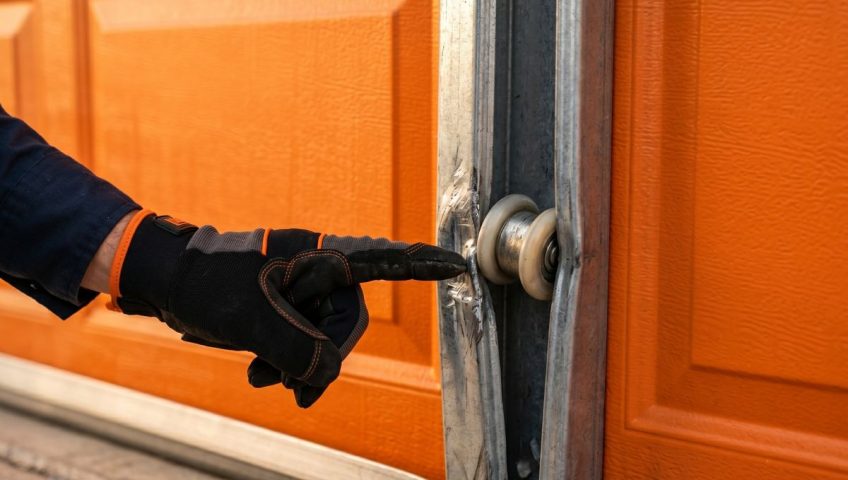
Tracks are aluminum or steel channels that run vertically up the wall and curve horizontally along the ceiling. A vehicle bumping the bottom of the track, a heavy impact, or even years of thermal expansion and contraction can bend a section enough that the rollers can no longer pass through cleanly. A dent as shallow as a quarter-inch is enough to derail a heavy steel door panel. Our track adjustment and replacement service addresses both minor realignment and full section replacement.

Broken Torsion or Extension Springs

The springs do the heavy lifting — they counterbalance the door’s weight so the opener only has to apply a small amount of force. When a spring snaps, the door becomes dramatically heavier on one side. The opener pulls anyway, the cables tension unevenly, and the door torques sideways off the track. Garage door spring installation and repair is one of the most technically demanding jobs we perform, and it’s not one we recommend attempting without professional training and the right tools.

Loose or Snapped Cables

Lift cables run from the bottom corners of the door up to the spring drum. A frayed or snapped cable causes the same imbalance problem as a broken spring — one corner drops, the door skews, and the rollers pop out. Cable repairs go hand-in-hand with residential garage door repair and should always be inspected together with the springs.

Misaligned Track Brackets

The brackets that bolt the track to the wall can loosen over time due to vibration. Even a few millimeters of lateral shift in one bracket changes the geometry enough to cause binding or derailment. We retighten and realign brackets as part of every garage door maintenance visit we perform in Mesa and the surrounding metro area.

Cause of Derailment Visible Signs DIY-Safe? Recommended Action
Worn or broken rollers Door wobbles, grinds, or scrapes on one side Partial Replace all rollers; call a tech for bottom-bracket rollers
Bent track section Visible dent or gap in track; door stops mid-travel No Track realignment or section replacement by a technician
Broken torsion spring Loud bang, door extremely heavy, visible gap in spring No Professional spring replacement only — high-tension hazard
Snapped lift cable Cable coiled on floor, door lower on one side No Cable and spring inspection by a trained technician
Loose track bracket Track visibly pulled away from wall; rattling sound Partial Tighten lag bolts; re-check alignment after tightening
Impact damage (vehicle strike) Dented panel, bent bottom bracket, misaligned rollers No Full inspection — multiple components likely affected
Obstruction in track Door stops suddenly; debris visible inside channel Yes Clear debris, inspect roller for damage before restarting
Opener force set too high Door slams on close, strains on open, rollers pop out repeatedly Partial Reduce force settings; inspect opener hardware and springs


What You Can Safely Inspect Before Calling Us

We always encourage Mesa homeowners to do a basic visual inspection before picking up the phone — not because we want you to attempt the repair yourself, but because the information you gather helps our technicians arrive prepared with the right parts.

Step 1 — Disconnect the Opener

Pull the red emergency release cord hanging from the opener trolley. This disengages the door from the drive mechanism so it can move freely on its own. Never operate an off-track door with the opener engaged — the motor will continue pulling against the derailed panel and can cause cable or opener damage.

Step 2 — Look at the Rollers and Track Gap

With a flashlight, examine each roller from the outside. Look for rollers that have completely left the track channel, cracked wheels, or rollers that are seated but visibly wobbling. Note which side of the door has the problem — left, right, or both.

Step 3 — Check for Obvious Track Damage

Run your eyes along the full length of both vertical tracks. A bent section usually looks like a visible pinch or wave in the metal. If you see a gap between the track bracket and the wall, that’s a loosened mounting point.

Step 4 — Inspect the Springs

Look up at the horizontal bar above the door. Torsion springs run along this bar and are easy to inspect: a broken spring has a visible separation or gap in the coil. Do not touch the spring, cables, or bottom brackets — these are under extreme tension even when the door is down.

Step 5 — Document and Call

Take a photo of the area where the door appears most obviously off-track. This is the single most helpful thing you can do before our garage door repair technicians arrive. We serve Mesa and the entire Metro Phoenix area, and our mobile units carry the most common replacement rollers, cable sets, and track hardware on every call.

How We Repair an Off-Track Garage Door in Mesa

When our technicians respond to an off-track garage door call, we follow a structured diagnostic and repair process that we’ve refined over years of work in the Valley. Here’s what that process looks like from start to finish.

Full-System Inspection First

Before touching any hardware, we assess the entire door system — not just the point of derailment. An off-track door is almost always a symptom rather than a standalone problem. We check spring tension, cable condition, roller wear, track geometry, bracket torque, and opener force settings all at once. This is what separates a proper repair from a patch job.

Roller Reinsertion and Track Realignment

For cases where the track is still straight and the rollers simply jumped out, we manually guide the rollers back into the channel using purpose-built tools that hold the track open just enough without damaging the metal. We then close the gap back to the manufacturer’s specified clearance — typically between 1/4 and 3/8 inch from the door panel edge — and verify smooth travel through the full range of motion.

Track Section Repair or Replacement

Bent track sections cannot simply be hammered back into shape. Deformed metal develops stress fractures that cause repeated failures. We use replacement track sections matched to the door’s weight class and panel width, re-plumb the vertical run with a level, and reset all bracket positions before securing. Our track adjustment and replacement service includes both the hardware and the alignment verification.

Spring and Cable Restoration

If a spring or cable caused the derailment, we address it as part of the same visit. We size replacement torsion springs to the door’s exact weight and height, using industry-standard DASMA specifications. Cables are replaced in pairs to maintain equal tension on both sides. After reinstalling springs and cables, we manually cycle the door several times to confirm balance before reconnecting the opener.

Opener Force Calibration

The final step is always testing the opener’s force and travel limits. An opener set too forcefully will re-derail a correctly aligned door over time. We use the opener’s built-in diagnostics to set force just above the door’s balanced operating load, then verify that the auto-reverse safety feature activates at the correct resistance — a critical garage door safety sensor check we perform on every single call.

When a DIY Attempt Makes Things Worse

We respect that Mesa homeowners are resourceful, and there are a handful of minor tasks — like clearing debris from a track or tightening a loose bracket — that are genuinely within reach of a handy homeowner. But we see a specific pattern of escalated damage from DIY attempts on off-track doors that we want to help you avoid.

Using a pry bar on the track is the most common mistake. Forcing a bent track section wider with a pry bar typically creates a second bend and can snap the bracket welds. What was a $150 track repair becomes a $350 full-side replacement.

Forcing the door closed manually when a roller is out tears the cable off the drum and can strip the cable anchor at the bottom bracket — turning a roller replacement into a full cable-and-drum job.

Reconnecting the opener before fixing the derailment is dangerous. The motor applies 20–50 lbs of force to an already compromised panel, which can cause the door to collapse laterally, bending multiple panels and damaging the opener trolley.

If you’re ever unsure whether a fix is within your skill level, the safest option is always to leave the door in place — disconnected from the opener — and call our commercial or residential team for a same-visit diagnosis. Our technicians have handled every variation of this problem and can tell you within minutes what the correct repair path is.

Preventing Off-Track Problems in Mesa’s Climate

Mesa’s desert climate creates specific stress patterns on garage door hardware that differ from what you’d find in cooler or more humid regions. Summer temperatures routinely push metal tracks and brackets through significant thermal expansion cycles. Here’s what we recommend to Mesa homeowners based on what we observe during maintenance calls.

Lubricate rollers and hinges every six months. Use a silicone-based or white lithium spray — not WD-40, which strips existing lubrication and attracts dust. Apply to rollers, hinge pivot points, and the torsion spring bar. Avoid spraying the track itself.

Inspect and tighten all visible lag bolts annually. The bolts securing track brackets to the wall work loose from vibration. A 3/8-inch socket and a few minutes once a year prevents the most common cause of gradual track drift.

Check roller condition every two years. Standard nylon rollers have a service life of 10,000–15,000 cycles. In a household that opens and closes the door four times daily, that’s roughly seven to ten years — but heat accelerates wear. If your rollers are more than eight years old and you haven’t had them inspected, schedule a maintenance visit through our garage door services page.

Schedule a professional tune-up after any vehicle impact. Even a slow-speed tap against the bottom track section transmits force upward through the entire vertical run. What looks like an undamaged track after a minor collision often has a hairline bend that causes derailment weeks or months later during normal operation.

A yearly preventive maintenance visit from Discount Garage Door Repair of Mesa catches these issues before they become emergency calls. Our technicians document the condition of every component so you have a clear picture of what’s working well and what needs attention in the coming season.

Frequently Asked Questions — Off-Track Garage Door Repair in Mesa, AZ

Is it safe to use a garage door that has come off its track?

No. An off-track door is structurally unstable and can drop or shift suddenly, posing a serious injury risk to anyone nearby. Disconnect the opener using the emergency release cord, leave the door in whatever position it’s currently in, and call a technician before attempting to use the door again.

Can I put a garage door back on track myself?

In some cases — such as a single roller that has popped out of a straight, undamaged track — a careful homeowner can reseat it. However, if the derailment was caused by a broken spring, snapped cable, bent track, or impact damage, a DIY attempt often leads to further damage or injury. We strongly recommend having a trained technician assess the root cause before any repair is attempted.

How long does an off-track garage door repair take?

Most off-track repairs are completed in one to two hours. If the cause is a broken spring, damaged cable, or a bent track section requiring a replacement part, the visit may run slightly longer. Our mobile technicians carry the most common hardware on every truck to minimize delays.

What does it cost to repair an off-track garage door in Mesa?

Cost depends on the root cause. A simple roller reinsertion and track alignment is one of the more affordable garage door repairs. Replacing a broken spring, cable, or a full track section adds to the total. We provide transparent, upfront pricing before any work begins — no surprise charges after the job is done.

How do I know if my garage door track is bent or just misaligned?

A misaligned track typically shows as a visible gap between the track and the door panel edge — usually wider on one side than the other. A bent track shows as a visible wave, dent, or crimp in the metal channel itself. Misalignment can sometimes be corrected by loosening and repositioning the bracket; a bent section almost always requires replacement to prevent repeat derailments.

Does Discount Garage Door Repair serve areas outside Mesa?

Yes. While we are based in Mesa, AZ, our mobile technicians serve the entire Metro Phoenix area including Gilbert, Chandler, Tempe, Scottsdale, and surrounding communities. Call (480) 531-7181 to confirm availability in your specific area.


Trust Discount Garage Door Repair of Mesa With Your Off-Track Door

An off-track garage door is not a problem that improves on its own. Left unrepaired, the structural imbalance puts added stress on the opener motor, accelerates roller and hinge wear, and increases the risk of a panel collapse — particularly on heavier steel and insulated doors common in Mesa-area homes.

At Discount Garage Door Repair of Mesa, our technicians have spent years working specifically on the types of doors found across Maricopa County — from the standard two-car panels in Dobson Ranch to the oversized commercial roll-ups in the Mesa industrial corridor near Falcon Field. We carry that local knowledge into every service call: we know which hardware brands are most common in this market, which failure modes are seasonal, and how to get the job done right the first time.

We invite you to read our related article on garage door spring repair if you suspect a broken spring contributed to your derailment — it covers the warning signs and explains exactly what the replacement process involves.

If your garage door is off-track right now and you need a technician in Mesa or anywhere in Metro Phoenix, don’t wait. Disconnect your opener, keep the area clear, and give us a call. Our mobile team is available for same-day service, and we arrive with the parts and tools to handle the most common causes of derailment in a single visit.

📞 Call Discount Garage Door Repair of Mesa now at (480) 531-7181 — or find us on the map and see why Mesa homeowners trust us with their garage door repairs. Your door should open the way it was designed to. We make sure it does.

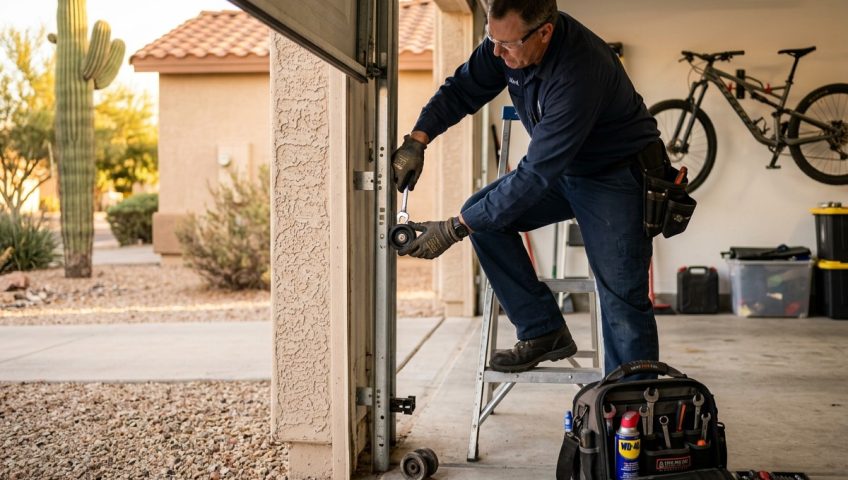
Garage door technician replacing worn rollers on a residential garage door in Mesa AZ

Garage Door Roller Replacement in Mesa AZ

Garage door rollers are one of the most overlooked components in the system — and one of the first to fail under Phoenix heat and daily use. When rollers wear out, the symptoms start subtle: a squeak on the way up, a slight vibration through the door, a grinding sound that wasn’t there six months ago. Left unaddressed, worn rollers transfer their load to the tracks, the hinges, and eventually the opener motor — turning a straightforward roller replacement into a more involved repair.

In Mesa, rollers wear faster than in moderate climates for two reasons. First, garage interiors regularly exceed 130°F in summer, which degrades the nylon and steel components in rollers faster than manufacturers’ rated cycle counts assume. Second, the dust and grit that moves through Mesa garages acts as an abrasive on roller stems and track surfaces, accelerating wear with every cycle. A roller that would last 10–12 years in a cooler, cleaner environment may need replacement in 6–8 years in a Mesa garage running multiple cycles per day.

Our mobile technicians at Discount Garage Door Repair of Mesa are available day and night for roller replacement throughout Mesa and the Metro Phoenix area. Find us on Google Maps to verify our location and read reviews from Mesa homeowners before you call. Roller replacement is one of the most straightforward garage door services we perform — most jobs are completed in under an hour in a single visit.

Over 10 years serving Mesa with transparent pricing. Written quote after inspection, before any work begins. No hidden fees.


How to Tell Your Rollers Need Replacing

Roller wear produces a recognizable pattern of symptoms that gets louder and more disruptive as the component degrades further:

  • Grinding or squeaking during operation — the most common early sign. Metal-on-metal contact or a dry roller stem running in the track bracket produces noise that increases over time.
  • Vibration through the door panels — worn rollers don’t ride smoothly in the track. The irregular contact transfers vibration into the door itself.
  • Door moves unevenly or hesitates — a roller that’s partially seized or has a flat spot from wear causes the door to catch or stutter mid-travel.
  • Visible roller damage — cracked nylon wheels, bent stems, or rollers that have jumped the track are visible during a basic inspection above the door.
  • Opener working harder than normal — the motor compensates for increased rolling resistance. A door that used to move smoothly now puts more load on the opener motor with every cycle.
  • Track scoring or gouging — when roller bearings fail and the steel stem contacts the track directly, it leaves visible scoring on the track interior. Track damage caught early is a track cleaning and new roller job. Caught late, it may require track replacement.

Any combination of these symptoms is the right time to call for an inspection. Rollers don’t self-correct — they get worse with continued use.


Nylon vs. Steel Rollers — What the Difference Means in Mesa

Nylon rollers are the standard for residential garage doors in Mesa. A quality nylon roller runs on sealed ball bearings inside the nylon wheel, which means the bearing handles the load and the nylon provides quiet, smooth contact with the track. Nylon rollers are significantly quieter than steel rollers and don’t require lubrication on the wheel surface. The sealed bearings protect the rolling mechanism from the dust and grit common in Mesa garages. High-cycle nylon rollers — rated for 20,000+ cycles — are available as upgrades over the builder-grade 10,000-cycle rollers installed in most Mesa homes.

Steel rollers are found on older homes and some commercial installations. They’re durable but loud, and they require more frequent lubrication to prevent the metal-on-metal contact that accelerates both roller and track wear. When steel rollers dry out in Mesa’s heat, the noise increase is immediate and significant. If your door was installed before 2000 and has never had rollers replaced, it almost certainly has steel rollers that are due for inspection.

When we replace rollers in Mesa, we use nylon rollers with sealed ball bearings as the standard replacement. If the door has a history of heavy use or the homeowner wants to reduce future maintenance frequency, we carry high-cycle roller options and walk you through the comparison before ordering.

Our roller and cable replacement service covers both components together when applicable — cables and rollers wear on the same timeline and are accessed from the same areas of the door, so replacing both in one visit is the most efficient approach when both are due.

Quick Diagnosis — What Your Door Is Telling You
Symptom Likely Cause What a Pro Checks
Grinding or squeaking during operation Worn or dry roller bearings Roller spin, bearing condition, stem wear in bracket
Door vibrates through panels Rollers with flat spots or irregular wear Full roller set inspection, hinge bracket wear
Door catches or stutters mid-travel Partially seized roller or track debris Roller rotation, track interior condition, alignment
Opener working harder than before Increased rolling resistance from worn rollers Door balance test, roller condition, spring tension
Visible scoring inside the track Roller bearing failed, steel stem contacting track Track interior damage depth, roller bearing condition
Cracked or chipped nylon roller wheel Heat degradation or impact damage Full roller set condition, hinge bracket integrity

What Roller Replacement Involves

Replacing garage door rollers requires removing each roller from its hinge bracket, sliding it out of the track, and installing the new roller in reverse sequence. The bottom two rollers — the lowest set on each side — are the exception. They sit in the bottom bracket that also anchors the lift cable. Removing the bottom bracket rollers requires releasing cable tension before the bracket can be safely accessed. This is the step that turns a DIY roller swap into a professional repair — cables under tension are not a component to work around without the right tools and training.

When our technician arrives at your Mesa home, the inspection covers all rollers in sequence from top to bottom, plus hinge condition, track interior surface, and cable condition. Worn hinges that are allowing the roller stem to wobble in the bracket get flagged — a new roller in a worn hinge bracket will wear faster than it should. Track scoring from failed bearings gets noted — light scoring can be smoothed; deep gouging means the track section needs replacement.

After the inspection we provide a written quote for the full scope of work. Most residential roller replacements — full sets of 10–12 rollers depending on door panel count — are completed in 45–60 minutes. If the cables show wear alongside the rollers, we address both in the same visit using our residential garage door repair service. If the track shows damage from extended roller wear, our track repair service covers that in the same call.

Frequently Asked Questions

How long does roller replacement take? +
A full residential roller replacement — typically 10 to 12 rollers depending on the door panel count — takes 45 to 60 minutes. We carry nylon roller sets for all standard residential door configurations on the truck, so there’s no wait for parts. If cables need replacement at the same time, we handle both in the same visit.
Can I replace garage door rollers myself? +
The upper and mid-panel rollers can technically be replaced without special tools, but the bottom rollers sit in the bottom bracket that anchors the lift cable under tension. Removing that bracket without releasing cable tension correctly can cause the cable to snap free suddenly. That’s the step that makes professional replacement the safer choice for a full roller set.
Should I replace all rollers at once or just the bad ones? +
All rollers on a door have the same cycle count and have been exposed to the same Mesa heat conditions. Replacing only the visibly failed ones leaves the rest at the same wear stage — they’ll each fail in sequence over the following months. Replacing the full set at once costs more upfront but eliminates the pattern of repeated service calls and gives you a consistent baseline for the entire door.
How long do new garage door rollers last in Mesa? +
Standard 10,000-cycle nylon rollers typically last 5 to 8 years in a Mesa garage running 4 to 6 cycles per day. High-cycle rollers rated for 20,000+ cycles extend that to 10 or more years under the same conditions. The difference in cost between standard and high-cycle rollers is modest — we give you the comparison and let you choose.
Will new rollers fix my noisy garage door? +
In most cases, yes. Grinding, squeaking, and vibration noise in a garage door is roller-driven the majority of the time. If the rollers are the source, new sealed-bearing nylon rollers eliminate the noise immediately. If noise persists after roller replacement, the next step is hinge inspection and track lubrication — we check both as part of every roller replacement visit.
Are you available for same-day roller replacement in Mesa? +
Yes. Our mobile technicians are available day and night throughout Mesa and Metro Phoenix. Roller replacement is a scheduled service in most cases — call (480) 531-7181 and we’ll get a technician to your Mesa home at a time that works for you.

Stop the Noise Before It Becomes a Bigger Repair

A grinding garage door in Mesa isn’t just an inconvenience — it’s a door telling you that its rollers are transferring wear to the tracks, the hinges, and the opener motor on every single cycle. The longer worn rollers run, the more components they affect. Catching it at the roller stage keeps the repair straightforward and the cost predictable.

Discount Garage Door Repair of Mesa has been serving Mesa homeowners for over 10 years with transparent pricing and same-day availability. Our mobile technicians carry nylon roller sets for all standard residential door configurations, and most jobs are finished in under an hour. Located at 1616 E Main St, Suite 207A in Mesa, we’re the local team for garage door repair throughout Mesa and Metro Phoenix.

Call (480) 531-7181 to schedule your roller inspection. Visit our contact page for non-urgent scheduling, or browse our full services menu for everything we cover in Mesa and the surrounding area.

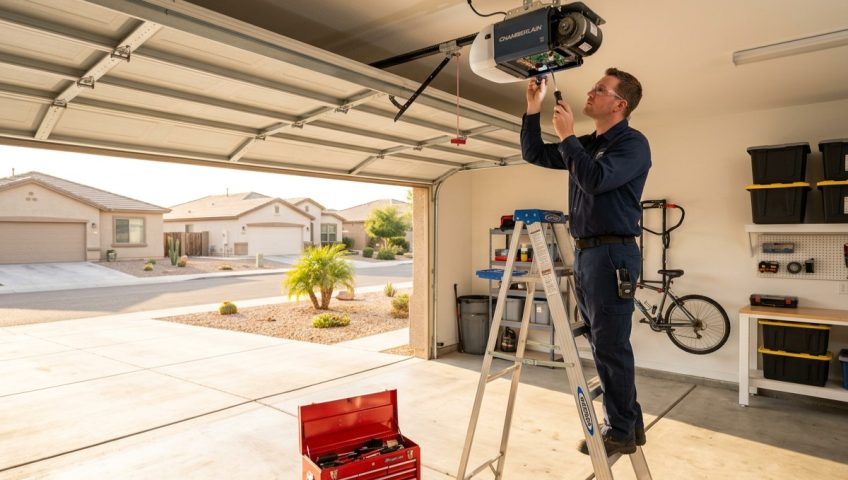
Garage door opener repair technician servicing a residential opener unit in a Mesa AZ garage

Garage Door Opener Repair in Mesa AZ

When your garage door opener stops working, the problem is almost always a single failed component — not the entire unit. A stripped drive gear, a burned-out capacitor, a misaligned safety sensor, or a worn drive belt each produce symptoms that look like total opener failure but cost a fraction of a full replacement to fix. Identifying that component accurately on the first visit is what separates a $90 repair call from an unnecessary $350 replacement.

Mesa’s climate creates specific stress conditions for garage door openers that most homeowners don’t factor into their maintenance planning. Garage interiors across the Phoenix metro routinely hit 130°F or higher in summer — sustained heat that hardens rubber drive belts, dries out gear lubrication, and degrades the run capacitors that power the motor through each cycle. An opener running in a Mesa garage accumulates heat fatigue on top of normal mechanical wear, which is why units here frequently need service years ahead of the manufacturer’s rated cycle life.

Our mobile technicians at Discount Garage Door Repair of Mesa are available day and night throughout Mesa and the Metro Phoenix area. Find us on Google Maps to check our location and read reviews from Mesa homeowners before you call. We carry diagnostic tools and common replacement parts for all major opener brands on every truck — most repairs are completed the same visit.

Over 10 years serving Mesa homeowners with transparent pricing and no hidden fees. Every repair starts with a written quote after the on-site inspection — no work begins until you approve it.

What Actually Fails — Common Opener Problems in Mesa

Stripped drive gear is the most frequent opener repair we perform in Mesa. Inside every chain-drive and belt-drive opener is a small plastic gear that transfers torque from the motor shaft to the drive mechanism. It’s engineered to fail before the motor burns out — the sacrificial component in the system. When it strips, the motor runs and you hear it activate, but the door doesn’t move. Gear replacement takes 30–45 minutes and restores full function without touching the motor or replacing the unit.

Run capacitor failure shows up as a motor that hums when activated but won’t start turning, or one that starts slowly and labors through the cycle. The capacitor stores and releases the charge that kicks the motor into motion. In Mesa’s sustained heat, capacitor fluid evaporates ahead of the rated service life and the component fails — sometimes gradually, sometimes all at once. Replacement is one of the least expensive opener repairs and resolves the problem immediately if the motor windings haven’t been damaged by repeated strained starts.

Safety sensor misalignment is the most frequently misdiagnosed opener problem. The two infrared sensors mounted at the bottom of the door tracks communicate via a beam — if that beam is broken or the sensors are out of alignment, the opener reads a permanent obstruction and refuses to complete the down cycle. The door either won’t close at all or reverses immediately. Sensor realignment costs far less than an opener replacement and is often the entire fix.

Remote and keypad failure is separate from mechanical failure. If the wall button works normally but the remote or keypad doesn’t respond, the issue is in the radio receiver or signal frequency — not the motor or drive system. We reprogram, replace, and upgrade remotes and keypads as a standalone service.

Motor or circuit board failure is the scenario where replacement makes financial sense. If the motor has burned out from years of running against a weak spring, or the circuit board has failed, component-level repair on an older unit often exceeds the cost of a current-model opener installation. We give you the honest cost comparison on site before recommending either direction.

Opener Types We Service in Mesa

Chain-drive openers are the most common in Mesa homes built before 2010. They’re mechanically simple and durable — parts are standardized across brands and widely available. The tradeoff is noise level, which matters more in homes where the garage shares a wall with a bedroom or main living area.

Belt-drive openers use a reinforced rubber belt instead of a chain, producing significantly less operating noise. These are standard in newer Mesa homes and attached garages adjacent to living spaces. The belt stretches and hardens over time — particularly in sustained heat — and may need tensioning or replacement before the motor develops any issues. We check belt condition on every opener inspection.

Jackshaft openers mount to the wall beside the door and drive it through the torsion bar rather than a ceiling-mounted trolley. Less common in Mesa residential properties, but found in homes with high ceilings or limited overhead clearance. We stock LiftMaster 8500 series components and service jackshaft units within standard opener repair scope.

Smart openers with Wi-Fi connectivity add a software diagnostic layer on top of the mechanical system. myQ-enabled units log error codes that identify whether the failure is motor load, sensor, or connectivity. We read those codes during the on-site inspection — they frequently point directly to the failed component before we open the housing.

Our full garage door opener repair and installation service covers all opener types. If the inspection reveals the problem is spring-related — an unbalanced spring overloading the opener motor is one of the most common misdiagnoses — our residential garage door repair team addresses springs, cables, and tracks in the same visit.

Quick Diagnosis — What Your Opener Is Telling You
Symptom Likely Cause What a Pro Checks
Motor runs, door doesn’t move Stripped drive gear Gearbox inspection, gear and sprocket condition
Motor hums but won’t start Failed run capacitor Capacitor test, motor winding integrity
Door reverses immediately when closing Safety sensor misalignment or obstruction Sensor beam alignment, lens condition, wiring
Wall button works, remote doesn’t Radio receiver or remote frequency issue Receiver test, remote reprogramming, antenna check
Door opens but won’t fully close Close limit switch needs adjustment Limit switch calibration, force adjustment setting
Opener moves door slowly or struggles Worn capacitor or spring losing tension Spring balance test, capacitor, motor amperage draw

How a Discount Garage Door Opener Call Works

When our technician arrives at your Mesa home, the inspection starts with a full operational test — activating the opener from the wall button, the remote, and the keypad if present, and watching the complete open and close cycle. We time the motor response, listen for abnormal sounds, and check whether the door maintains consistent speed through the full travel range.

From there we inspect the drive mechanism, gear condition, belt or chain wear and tension, trolley carriage, safety sensor alignment and lens condition, and limit switch calibration. We also disconnect the opener and test the door’s spring balance manually — a door that drops or rises when released mid-travel means the spring is forcing the opener to work against resistance on every single cycle.

After the inspection we provide a written quote covering all required repairs, with separate line items for parts and labor. No work begins until you review and approve it. Most standard repairs are completed in the same visit with parts already on the truck. If replacement is the better call, we walk you through current models and pricing before placing any order.

The job isn’t complete until the door runs a full test cycle in both directions and the safety auto-reverse function is confirmed working — every time, on every Mesa call.

Frequently Asked Questions

Do I need a new opener or just a repair? +
Most opener failures are single-component issues — a stripped gear, a dead capacitor, a misaligned sensor. These repairs cost a fraction of a full replacement and restore complete function. We diagnose the actual failed component on site and give you the honest comparison between repair and replacement cost before any work begins.
How long does an opener repair take in Mesa? +
Most standard repairs — gear replacement, capacitor swap, sensor realignment, limit switch adjustment — take between 30 and 60 minutes after the diagnostic. We carry common parts for all major brands on the truck, so most jobs are finished the same visit without waiting on parts orders.
What opener brands do you service in Mesa? +
We service all major residential opener brands including LiftMaster, Chamberlain, Genie, Craftsman, Linear, and Overhead Door. We also service myQ smart opener systems and diagnose connectivity issues separately from mechanical failure. Call (480) 531-7181 with your brand and model — we’ll confirm parts availability before dispatch.
Why does Mesa heat affect garage door openers? +
Mesa garage interiors regularly reach 130°F in summer. At those temperatures, rubber drive belts harden and crack, gear lubricant dries out and increases friction load, and run capacitors lose fluid and fail earlier than rated. Openers that receive annual maintenance — lubrication, belt tension check, capacitor condition inspection — last significantly longer in the Phoenix climate than those running without service.
Do you provide a written quote before repairs begin? +
Yes, always. After the on-site inspection we provide a written quote with separate line items for parts and labor. No work begins until you’ve reviewed and approved it. There are no hidden fees or charges added after the repair is complete — transparent pricing on every Mesa call.
Are you available for same-day opener repair in Mesa? +
Yes. Our mobile technicians are available day and night throughout Mesa and Metro Phoenix. A door stuck open or closed is a priority dispatch — call (480) 531-7181 and we’ll get the nearest available technician to your Mesa location as quickly as possible.

The Right Repair Starts with the Right Diagnosis

Most Mesa homeowners dealing with an opener problem don’t need a new unit — they need a technician who accurately identifies the failed component before recommending one. A stripped gear is a gear replacement. A dead capacitor is a capacitor swap. A misaligned sensor is a five-minute alignment. Each costs a fraction of a full opener replacement and restores complete function.

Discount Garage Door Repair of Mesa has been serving Mesa homeowners for over 10 years with transparent pricing and same-day availability. Our mobile technicians carry parts for all major opener brands — LiftMaster, Chamberlain, Genie, Craftsman, Linear, and more — and complete most repairs in a single visit. Located at 1616 E Main St, Suite 207A in Mesa, we’re your local team for everything your garage door needs.

Call (480) 531-7181 to schedule your opener inspection. Visit our contact page for non-urgent scheduling, or browse our full services menu for everything we cover in Mesa and Metro Phoenix.

Garage Door Opener Repair vs Replacement in Mesa

Garage Door Opener Repair vs Replacement in Mesa: How to Choose the Right Fix

When your garage door won’t open, stops halfway, reverses for no reason, or starts making loud grinding noises, it’s not just annoying—it can trap your car, leave your home unsecured, or shut down access at a business. In many Mesa neighborhoods (and across Phoenix, Tempe, and Chandler), opener problems show up fast: one day it’s “a little slow,” the next day you’re stuck staring at a door that won’t move.

This guide explains garage door opener repair vs replacement in Mesa, so you can make a confident decision based on safety, reliability, and long-term value. If you’re searching for Garage door repair Mesa AZ with same day garage door service, start here with Discount Garage Door Repair Mesa AZ:
Discount Garage Door Repair Mesa AZ

The #1 Mistake Homeowners Make: Replacing the Opener When the Door Is the Problem

Before you spend money replacing an opener, confirm the door is moving correctly. A garage door opener is designed to move a balanced door—not drag a door that’s heavy, off-track, or binding.

If you want a “big picture” view of what’s available, browse the full service hub:
Garage Door Services

Common “Opener Problems” That Are Actually Door Problems

If your opener strains, clicks, hums, or stops, these door issues may be the real cause:

If your door is stuck right now, this troubleshooting post explains the most common causes (without unsafe DIY steps):
Garage Door Won’t Open Mesa? 6 Common Reasons Why Your Door is Stuck

Quick Steps: How to Decide Repair vs Replacement (Without Guessing)

Step 1: Identify the symptom

  • Door won’t move, opener hums, or chain/belt moves but the door doesn’t

  • Door reverses immediately

  • Door stops halfway

  • Loud grinding, rattling, or screeching

  • Remote works sometimes (intermittent)

Step 2: Confirm safety basics (safe checks only)

  • Replace remote battery

  • Make sure sensors aren’t blocked

  • Check the opener has power

Step 3: Schedule a professional diagnosis (fastest way to avoid wasted money)

Book an inspection here: Contact Us

When Garage Door Opener Repair Is the Best Choice in Mesa

In many homes, garage door opener repair is the smartest option when the unit is still in decent condition and the issue is isolated.

Start here if you want opener-specific service:
Garage Door Opener Repair & Installation

Repair is usually the right move when:

  • The opener has been reliable until recently

  • The opener responds, but performance is inconsistent

  • The issue involves sensors, settings, remotes, wiring, or worn internal parts

  • Your door is balanced and not binding (a technician can confirm)

Common opener repairs that are often cost-effective

  • Sensor repair/alignment (reduces reversals and “won’t close” issues)

  • Gear/drive component repairs (often behind grinding noises)

  • Travel/force adjustments (stops early, reverses, or slams)

  • Remote/keypad programming and signal troubleshooting

  • Electrical and control-board diagnosis (intermittent operation)

If you want to explore educational content related to openers, here are two helpful reads:

When Replacement Is the Smarter Long-Term Fix

Sometimes replacement is the better decision—not because repair is impossible, but because reliability and safety matter more than “one more patch.”

Replacement tends to be smarter when:

  • The opener is older and failing repeatedly

  • You’ve had multiple repairs and performance is still inconsistent

  • The unit is underpowered for the door (especially after a heavier door upgrade)

  • Noise is excessive and constant

  • You want a fresh start with a properly matched system

Replacement should always include a door balance check. If the door is heavy due to spring issues, the new opener can fail early unless the spring system is corrected first. That’s why spring work often comes before opener replacement:
Garage Door Spring Repair for Reliable Performance

Repair vs Replacement Comparison Table

Decision Factor Opener Repair Usually Wins Opener Replacement Usually Wins
Reliability history Worked well until recently Frequent failures or “on/off” performance
Root cause Isolated issue (sensors/gear/settings) Multiple failures or motor/control issues
Door condition Door is balanced and smooth Door upgrade needs a better-matched opener
Long-term value One repair restores stability Repairs keep stacking up
Noise/comfort Minor adjustments reduce noise Old unit stays loud no matter what

Residential vs Commercial: Why Usage Changes the Answer

Residential garage door repair (Mesa homes)

Home openers often struggle because the door slowly develops friction—rollers wear, tracks drift out of alignment, springs weaken. If you want a full-system approach (opener + hardware), start here:
Residential Garage Door Repair

Commercial garage door repair (overhead doors, warehouses, storage)

Commercial doors usually face heavier loads and higher cycle counts. A failing operator can mean downtime and security risk, so the “best” choice is the one that restores reliable daily operation fast. Start here:
Commercial Garage Door Repair

And if you manage commercial openers, this resource is useful:
Garage Doors Openers Repair for Commercial Properties in Mesa

Emergency Situations: When You Need Same-Day Service

If your garage door is stuck open, stuck closed with a vehicle trapped, or the door is crooked/off-track, it becomes a safety and security issue. That’s when emergency garage door repair and same day garage door service matter most.

Emergency help:
Emergency Garage Door Repair

Don’t Ignore Related Damage: Panels, Tracks, and Rollers Affect Opener Life

Opener decisions get easier when the door itself is healthy.

Garage door panel replacement (damage can twist the door)

If panels are bent or cracked, the door can bind and overload the opener. Learn more:
Garage Door Panel Repair for Your Business Needs
Browse the topic hub: Garage Door Panels Category

Track performance matters (binding causes reversals)

A track that’s slightly off can trigger constant opener strain. Learn more:
Garage Door Track Repair for Reliable Performance
Topic hub: Garage Door Tracks Category

Rollers and hinges reduce friction (and noise)

If your door shakes or screams when moving, rollers are often the culprit. Topic hub:
Rollers & Hinges Category

Local Service Areas: Mesa, Phoenix, Tempe, Chandler (And Nearby)

Discount Garage Door Repair Mesa AZ supports homeowners and businesses throughout the East Valley and Metro area, including Mesa, Phoenix, Tempe, Chandler, and nearby communities. If you want to explore ongoing tips and updates, visit:
Discount Garage Door News

Why Customers Choose Discount Garage Door Repair Mesa AZ

When you need affordable garage door repair without guesswork, here’s what matters:

  • Fast response and same-day availability (when scheduling allows)

  • Experienced technicians who diagnose the root cause (not just symptoms)

  • High-quality parts matched to the door and opener system

  • Clear recommendations between repair vs replacement

  • Residential and overhead garage door repair support for commercial needs

Learn more about the team:
About Us

Want to leave feedback or find review links quickly?
Share & Review

(And if you need it for your site footer: Privacy and Terms)

Schedule Service Today (Repair or Replacement Done Right)

If you’re stuck deciding between garage door opener repair and garage door opener installation (replacement) in Mesa, don’t guess—get a professional diagnosis that checks the entire system: springs, cables, rollers, tracks, panels, and the opener itself. That’s how you avoid repeat breakdowns and protect your investment.

✅ Request same-day repair
✅ Schedule service today
✅ Ask for a full safety and performance check

Book now: Contact Discount Garage Door Repair Mesa AZ

Garage Door Spring Replacement in Mesa

Garage Door Spring Replacement in Mesa: What to Expect

If you heard a sudden loud bang, your garage door feels extremely heavy, or the door won’t open more than a few inches, you’re likely dealing with a broken spring. In Mesa, this problem often turns into an immediate disruption—cars trapped, doors stuck open (security risk), or an opener straining so hard it starts grinding.

This guide explains Garage Door Spring Replacement in Mesa: What to Expect, including safety steps, how a professional replacement is done, what related parts may need attention (cables, rollers, tracks), and how to prevent the next failure. For Garage door repair Mesa AZ and same day garage door service, start with Discount Garage Door Repair Mesa AZ:
Discount Garage Door Repair Mesa AZ

Why Springs Fail (And Why It Feels Like an Emergency in Mesa)

Garage door springs do the heavy lifting. When they’re healthy, your opener only guides the door. When a spring breaks, the door becomes dead weight—often 150+ pounds—leading to:

  • A door that won’t lift or only lifts a few inches

  • A door that slams shut or won’t stay open

  • An opener that strains, hums, or grinds

  • Cables that loosen or snap due to sudden imbalance

If your door is stuck open or unsafe, treat it as emergency garage door repair and request help right away:
Emergency Garage Door Repair

Torsion vs Extension Springs (What You Might Have)

Torsion Springs (Most Common)

Mounted above the door on a shaft. They deliver smoother lifting and are commonly tied to garage door torsion spring repair needs when they wear or break.

Learn more about the service process here:
Garage Door Spring Installation

Extension Springs (Often on Older Systems)

Mounted along the sides and stretch during operation. They require proper safety cables and correct matching to door weight.

If you want a deeper overview of spring systems and upkeep, these resources help:
Garage Door Springs: Trusted Residential Service in Mesa
Garage Door Springs Archive
Garage Door Springs Tag

Signs You Need Spring Replacement (Now vs “Soon”)

“Now” signs (stop using the opener)

  • Loud bang + door won’t open

  • Door is extremely heavy

  • Door opens a few inches then stops

  • Door is crooked or cables look loose

  • Opener strains or makes grinding noises

“Soon” signs (schedule before it breaks)

  • Door feels slightly heavier than usual

  • New squeaking or tension noises near the spring area

  • Door moves unevenly or hesitates

  • You see rust/corrosion or a stretched-looking spring

If the door won’t open at all, this troubleshooting guide is helpful before you call:
Garage Door Won’t Open Mesa? 6 Common Reasons Why Your Door is Stuck

Safety First: What to Do Immediately If a Spring Breaks

Here’s the safest approach while waiting for a technician.

Steps

  1. Stop using the opener (it can burn out or strip gears).

  2. Keep the door closed if possible (a stuck-open door is a security risk).

  3. Do not attempt DIY spring work—springs are under high tension.

  4. Keep children and pets away from the garage door area.

  5. Call for same-day service if your car is trapped or the door won’t secure.

To book fast service, go here:
Contact Discount Garage Door Repair Mesa AZ

What to Expect During a Garage Door Spring Replacement Appointment

A professional spring replacement should never be “swap and go.” The correct process restores balance and protects every other component.

1) System Inspection (Not Just Springs)

A technician typically checks:

  • Spring condition and correct sizing

  • Cable wear and drum alignment

  • Roller wear and track condition

  • Bearing plates, hinges, and fasteners

  • Opener strain and travel settings (if needed)

This is why spring work often overlaps with overhead garage door repair in general, especially when the door is binding or off-track.

To see the full service lineup, visit:
Garage Door Services

2) Correct Spring Selection + Matching Door Weight

The “quality” of a spring replacement is mostly determined by correct sizing and balance. That means matching the spring to:

  • Door height and width

  • Door weight (insulated doors need different springs)

  • Lift type and hardware configuration

For related spring services and repairs, this page is useful:
Garage Door Spring Repair

3) Safe Removal + Installation (High-Tension Work)

Professionals secure the door, release tension safely (torsion), and install new springs using proper tools and procedures.

If you want the dedicated service page for spring replacement scheduling, use:
Garage Door Spring Installation

4) Door Balance Test (The Most Important Part)

After installation, the door should:

  • Lift smoothly

  • Stay at mid-height without drifting

  • Close without slamming

  • Reduce strain on the opener

If your opener has been struggling, it may also need inspection or reset:
Garage Door Opener Repair & Installation
Garage Door Opener Repair and Maintenance in Mesa
Garage Door Openers Repair: Expert Solutions for Your Home

5) Final Safety Checks + Smooth-Travel Verification

A proper finish includes verifying:

  • Even cable tension

  • Track alignment

  • Roller movement and noise level

  • Opener safety reverse and sensors (as needed)

Track issues are common in Mesa due to dust, heat expansion, and daily wear. If your door binds or scrapes, track service may be recommended:
Garage Door Track Service
Garage Door Track Repair for Reliable Performance
Garage Door Tracks Category


Table: Symptoms That Often Come With Broken Springs (And What They Usually Need)

What you notice Most likely cause Service that fixes it
Loud bang + door won’t lift Broken torsion spring Garage Door Spring Installation
Door lifts unevenly / crooked Cable/drum issue after spring failure Garage Door Cable and Drum Repair
Grinding / squealing during movement Worn rollers or track drag Garage Door Roller Replacement + Garage Door Track Service
Opener hums but door doesn’t move Door is too heavy / out of balance Spring replacement + Opener Repair
Door stuck open late at night Unsafe/urgent condition Emergency Garage Door Repair

Related Repairs Often Done With Spring Replacement (To Prevent Repeat Breakdowns)

Spring failures frequently reveal wear elsewhere. Addressing these at the same time is how you reduce repeat service calls and keep the repair truly “affordable” long-term.

Garage door cable repair (and drum alignment)

If cables are frayed or uneven, fix them while the system is being balanced:
Garage Door Cable and Drum Repair
Drum & Cables Category
Drum Tag

Garage door roller replacement

Worn rollers add drag, noise, and strain (which shortens spring and opener life):
Garage Door Roller Replacement & Repair
Rollers & Hinges Category

Garage door panel replacement (when the door gets twisted or dented)

A damaged panel can throw alignment off and create binding:
Garage Door Panels Category
Garage Door Panel Repair

Off-track situations

If the door is off-track, spring replacement may be only part of the solution. A full system alignment is often needed through a complete repair inspection:
Repair Category

Residential vs Commercial Spring Replacement in Mesa

Residential garage door repair

Homeowners usually want quiet, smooth operation and opener protection. If your spring issue is affecting daily access, start here:
Residential Garage Door Repair

Commercial garage door repair (overhead doors)

Commercial doors are heavier, higher cycle, and downtime matters. For businesses in Mesa and Metro Phoenix, spring issues often affect security and workflow. Start here:
Commercial Garage Door Repair
Commercial Garage Door Openers Repair

How Long Does Spring Replacement Take (And What Impacts Timing)

Most spring replacements can be completed the same day, depending on:

  • Spring type (torsion vs extension)

  • Door size/weight (single vs double, insulated vs standard)

  • Condition of cables, rollers, bearings, and tracks

  • Whether the opener also needs adjustment after balancing

If your priority is fast restoration, request same day garage door service through:
Contact Us

Maintenance Tips to Extend Spring Life in Arizona

Even quality springs wear out, but garage door maintenance service habits reduce friction and stress:

  • Lubricate springs and hinges periodically (dust + dry metal accelerates wear)

  • Address noise early (noise usually = friction or misalignment)

  • Replace worn rollers before they damage tracks

  • Keep the door balanced so the opener isn’t pulling extra weight

For ongoing tips and local updates, visit:
Discount Garage Door News

Service Area: Mesa, Phoenix, Tempe, Chandler (and Surrounding Areas)

This guide is designed for homeowners and businesses searching across Mesa, Phoenix, Tempe, Chandler, and nearby East Valley communities. For directions, use:
Find us on Google Maps

Why Choose Discount Garage Door Repair Mesa AZ

When you want affordable garage door repair that’s still professional and safe, the process matters as much as the parts:

  • Correct diagnosis (springs + cables + rollers + tracks)

  • Proper spring sizing for your door

  • Balanced door operation to protect the opener

  • Clear recommendations with no guesswork

Learn more about the company approach here:
About Us

After service, customers can share feedback here:
Share & Review

Site policies:
Privacy and Terms

Schedule Spring Replacement in Mesa Today

If your door is heavy, stuck, or you heard that “bang,” don’t force it—spring failures can lead to cable damage, off-track issues, and opener burnout. For Garage Door Spring Replacement in Mesa, contact Discount Garage Door Repair Mesa AZ and request same day garage door service or schedule a convenient appointment:

✅ Start here: Discount Garage Door Repair Mesa AZ
✅ Book service: Contact Us
✅ Spring service page: Garage Door Spring Installation

Garage Door Won’t Open Mesa? 6 Common Reasons Why Your Door is Stuck

If your garage door won’t open Mesa homeowners often find themselves frustrated and stuck, but the solution usually lies in identifying a failed component like a broken torsion spring, misaligned sensors, or a stripped opener gear. At Discount Garage Door Repair Mesa AZ, we recommend checking your remote batteries and power source first; if those are functional, professional recalibration or part replacement is likely required to restore safety and operation.

Navigating the Frustration of a Stuck Garage Door in Mesa

We have all been there. You are sipping your morning coffee, ready to head out to Usery Mountain Regional Park or perhaps just commuting to work, you press the button, and… nothing happens. Or worse, you hear a loud “bang” and the motor whines, but the door stays firmly shut. When your garage door won’t open, Mesa heat and daily wear-and-tear are often the silent culprits behind the scenes.

As a local team with years of hands-on experience in the East Valley, we’ve seen how the Arizona climate affects mechanical components. From the expansion of metal tracks in the summer to the drying out of essential lubricants, your garage door is a complex system of moving parts that requires precision to function. In this guide, we are going to walk you through the six most common reasons for this failure, how we diagnose them, and why professional intervention is vital for your safety.

1. The Dreaded Broken Torsion Spring

In our years of servicing homes across Maricopa County, the number one reason a garage door won’t open in Mesa is a snapped torsion spring. These springs are the “muscles” of your door, doing the heavy lifting so the motor doesn’t have to.

How to Identify a Broken Spring

Most springs are rated for about 10,000 cycles. Once they reach their limit, they snap—often with a sound like a gunshot. If you look above your door and see a visible gap in the coil, the spring is broken. We strongly advise against trying to lift the door manually or replacing these yourself. The tension held within these components is immense and can cause serious injury without the proper Garage Door Spring Repair tools and training.

Our Professional Approach

When we arrive at your property, we don’t just swap a part. We calculate the specific wire gauge and length required for your door’s weight to ensure a perfect balance. Our technicians are highly trained and follow strict safety protocols to ensure your home remains a safe environment.

2. Misaligned or Obstructed Safety Sensors

If your motor hums or the light flashes, but the garage door won’t open, Mesa sunshine might actually be the problem. The “eyes” at the bottom of your tracks are designed to stop the door if an object is in the way.

  • Sunlight Interference: In Mesa, the intense afternoon sun can “blind” the infrared beam.

  • Dirt and Cobwebs: Dust storms are common here; a simple layer of Arizona dust on the lens can break the signal.

  • Physical Misalignment: A trash can or a bicycle might have bumped the sensor out of place.

We often find that a simple realignment or cleaning solves the issue. However, if the wiring has frayed due to pests or age, we provide expert Garage Door Sensor Alignment and replacement services to get you back on track.

3. Snapped or Loose Lifting Cables

Working in tandem with your springs are the lifting cables. If a spring breaks, the cables often fly loose or become frayed. If you notice your door is hanging crookedly, it’s a sign that a cable has slipped or snapped.

When your garage door won’t open, Mesa residents should look for “silver hair” fraying on the steel cables. This indicates the metal is failing. Because these cables are under the same high tension as the springs, we treat these repairs with the highest level of technical expertise. Our team ensures that the drums are set correctly and the tension is equalized across both sides of the door.

4. Garage Door Opener Malfunctions

Sometimes the door itself is fine, but the “brain” of the operation—the opener—has failed. As a premier provider of Garage Door Opener Repair, we see several common electronic and mechanical failures:

  • Stripped Gears: If you hear a grinding noise like plastic teeth rubbing together, the internal drive gear is likely stripped.

  • Logic Board Failure: Power surges (common during monsoon season) can fry the circuit board.

  • Limit Settings: The opener may “think” the door is already open or closed, requiring a limit reset.

We carry a wide range of parts for major brands. Our transparency means we will always tell you if a repair is cost-effective or if a new, more efficient Garage Door Installation is a better long-term investment.

5. The Door is Manually Locked or in “Holiday Mode”

It sounds simple, but we have been on many service calls where the fix was just a flip of a switch. Many Mesa homes have manual slide locks on the inside of the door for extra security. If someone in the family engaged the lock, the garage door won’t open and trying to force it can burn out your motor.

Additionally, many wall consoles have a “Lock” or “Holiday” button. If this is pressed, the remotes will be disabled. Check your wall station to see if the green light is flashing; this usually indicates the lock feature is active. If you’ve checked these and the door still won’t budge, it’s time to call in the experts at Discount Garage Door Repair Mesa AZ.

6. Track Misalignment and Obstructions

Your garage door travels along metal tracks. If these tracks are bent, rusted, or have a pebble stuck in them, the door will bind. Given our dusty environment, grit can build up in the tracks, mixing with old lubricant to create a “sludge” that prevents smooth movement.

We specialize in Garage Door Track Adjustment. We use precision tools to ensure your tracks are perfectly plumb and square. A door that is slightly off-track puts an enormous strain on every other part of the system, leading to premature failure of the motor and springs.

Why Choose Discount Garage Door Repair Mesa AZ?

When you are searching for help because your garage door won’t open, Mesa has many options, but we pride ourselves on our deep technical expertise and commitment to the community.

Hands-On Experience

We don’t just send “salespeople” to your home. We send technicians who have spent years in the field. We have repaired thousands of doors across zip codes like 85201, 85224, and 85208. We know the specific housing styles in Mesa and the common issues associated with different builders.

Training and Certifications

Our team undergoes regular training to stay up-to-date with the latest smart-home integrations and safety standards. We are fully insured and bonded, providing you with peace of mind that your property is in professional hands.

Transparency and Reputation

We believe in honest pricing. Before any work begins, we provide a full diagnostic report and a clear estimate. Our positive online reputation is built on one successful repair at a time. We don’t believe in “quick fixes” that will break again in a month; we believe in doing the job right the first time.

Maintaining Your Garage Door in the Arizona Heat

Prevention is always better than a breakdown. To avoid the “my garage door won’t open Mesa” panic, we recommend a bi-annual maintenance routine:

  1. Lubrication: Use a silicone-based lubricant on the hinges, rollers, and springs. Avoid WD-40, as it can actually attract dust.

  2. Tighten Hardware: Vibrations from the door moving can loosen bolts over time.

  3. Visual Inspection: Look for frayed cables or gaps in the springs.

  4. Balance Test: Disconnect the opener and see if you can lift the door halfway with one hand.

If you aren’t comfortable performing these checks, our Garage Door Maintenance packages are designed to keep your system running smoothly year-round.

Common Signs You Need Professional Help

While some minor issues can be DIY, most garage door problems require technical expertise. You should call us immediately if:

  • The door makes a loud, grinding noise.

  • The door moves much slower than usual.

  • You see any loose cables hanging by the sides.

  • The door appears crooked or off-balance.

  • The wall button works, but the remotes don’t.

Our local Mesa team is equipped with fully stocked trucks, meaning we can usually complete your Garage Door Repair in a single visit. We value your time and know that a stuck garage door is more than just an inconvenience—it’s a security risk for your home.

The Importance of Safety Standards

Every year, thousands of people are injured by garage doors. Because these are the heaviest moving objects in your home, safety is our top priority. We strictly follow all industry safety standards, ensuring that auto-reverse mechanisms are functional and that all components are rated for the weight of your specific door. When we perform a Garage Door Safety Inspection, we check over 25 different points of failure to ensure your family remains safe.

Local Expertise You Can Count On

We love serving the Mesa community. Whether you are located near the Mesa Arts Center or out toward Eastmark, we are your local neighbors. We understand the specific challenges of living in the Sonoran Desert, from the monsoons that can knock out power to the heat that degrades rubber seals.

We also offer specialized services like New Garage Door Quotes if you are looking to upgrade your home’s curb appeal. A new, insulated door can even help lower your cooling costs during those 110-degree July days!

Conclusion: Getting Your Door Back on Track

When your garage door won’t open, Mesa heat and mechanical fatigue are usually the culprits, but you don’t have to tackle the repair alone. From broken springs to faulty openers, we have the experience and the tools to diagnose and fix the problem quickly and safely. Dealing with a stuck door is a major disruption to your day, but with our transparent pricing and expert technicians, we make the repair process as seamless as possible.

If you found this guide helpful, you might also want to read our article on How to Choose the Right Garage Door for Your Arizona Home. We are committed to being your go-to resource for all things garage doors in the Valley.

Need Immediate Help? Don’t let a broken door ruin your schedule. If your garage door won’t open in Mesa, contact the professionals at Discount Garage Door Repair Mesa AZ today. Our friendly team is ready to provide you with fast, reliable, and affordable service.

Call us now at (480) 531-7181 or visit https://discount-garage-door-repair-mesa-az.com/ to schedule your same-day service!

Garage Door Springs: Trusted Residential Service in Mesa, Arizona

At Discount Garage Door Repair of Mesa, Arizona, we know how essential a reliable garage door is for your home. Whether it’s safeguarding your belongings, improving convenience, or enhancing curb appeal, your garage door works hard every day. At the core of its functionality are garage door springs, a vital component that ensures smooth and safe operation.

Garage door springs carry the immense weight of the door, allowing it to open and close effortlessly. Without them, your garage door simply wouldn’t work. However, like any mechanical part, springs are subject to wear and tear. Ignoring their maintenance can lead to malfunctions, higher repair costs, and even safety hazards.

repairing broken spring

Our team specializes in professional repair and replacement of garage door springs for residential properties in Mesa, Arizona. With our expertise, we ensure your door functions as intended, providing you with the reliability and peace of mind you deserve.

Common Issues with Garage Door Springs

There are two main types of springs in most residential garage doors: torsion springs and extension springs. Both types are engineered to handle the heavy lifting required to open and close the door. However, their constant use means they’re prone to eventual failure.

Some common issues with springs include:

  1. Rust or Corrosion: Over time, exposure to moisture can cause springs to corrode, weakening their performance. Regular lubrication helps combat this problem.
  2. Overstretching: Springs that are overstretched lose their tension, causing the door to feel heavy or become unbalanced.
  3. Sudden Breakage: A loud snap often signals that a spring has broken, rendering the garage door inoperable.
  4. Wear and Tear: After years of regular use, springs naturally weaken, often requiring replacement.

garage door spring maintenance

Why Professional Services Matter

Attempting to repair or replace garage door springs on your own can be dangerous. These components are under high tension, and improper handling can result in serious injuries or damage to your garage door system. Professional service ensures that:

  • The right type of spring is selected for your door’s weight and size.
  • Proper installation techniques are used to restore balance and functionality.
  • Your entire garage door system is inspected for potential issues.

At Discount Garage Door Repair, our technicians are trained to handle springs safely and efficiently. We use high-quality parts and industry-leading techniques to deliver lasting results.

Extending the Life of Your Garage Door Springs

While springs will eventually wear out, regular maintenance can significantly extend their lifespan. Here are a few tips to keep your springs in great shape:

  • Lubricate regularly: Apply a silicone-based lubricant to reduce friction and prevent rust.
  • Balance the door: An unbalanced door puts extra strain on the springs. Have it checked by a professional.
  • Avoid overuse: Limit the number of cycles your door completes daily if possible.

Our team also offers maintenance services to keep your entire garage door system in peak condition.


FAQs

  1. How can I tell if my garage door needs spring repair?
    Common signs include difficulty operating the door, loud squeaking noises, or visible damage to the springs.
  2. What’s the difference between torsion and extension springs?
    Torsion springs are mounted above the door and use torque to lift it, while extension springs are located on the sides and stretch to open the door.
  3. Why shouldn’t I attempt spring repairs myself?
    Garage door springs are under immense tension. Improper handling can lead to serious injury or damage. Always rely on professionals.
  4. How long do garage door springs typically last?
    Most springs last 7-10 years or approximately 10,000 cycles, depending on usage and maintenance.
  5. What should I do if my spring breaks suddenly?
    Stop using the garage door immediately and contact a professional for repairs to avoid further damage.

fixing garage door springs

Contact Us Today

If you’re experiencing issues with your garage door or suspect a problem with the springs, don’t wait for it to get worse. At Discount Garage Door Repair, we take pride in providing reliable, affordable, and professional services to homeowners in Mesa, Arizona. Whether it’s a minor adjustment or a complete spring replacement, we’ve got you covered.

Contact us today to schedule your service and ensure your garage door continues to operate smoothly and safely.

Garage Doors Openers Repair for Commercial Properties in Mesa

Garage Doors Openers Repair for Commercial Properties in Mesa

Functional garage door openers are essential for any commercial property. They provide secure and efficient access, whether you manage a warehouse, retail store, or office. However, when these systems malfunction, they can disrupt operations and create security risks. Discount Garage Door Repair of Mesa Arizona specializes in garage doors openers repair, offering professional and timely solutions to keep your business running smoothly.

new opener installed

Why Garage Door Openers Are Critical for Businesses

Garage door openers do more than just open and close doors—they ensure the safety, security, and efficiency of your business. When an opener fails, it can lead to operational delays, compromising productivity and customer satisfaction. Common issues include unresponsive openers, loud noises during operation, or inconsistent performance.

Regular maintenance and timely repairs can prevent these problems from escalating. Our team at Discount Garage Door Repair of Mesa Arizona understands the unique demands of commercial properties and delivers services designed to restore your garage door system promptly.

Comprehensive Garage Doors Openers Repair Services

At Discount Garage Door Repair of Mesa Arizona, we address a variety of issues that can impact the functionality of your commercial garage door opener. From motor repairs to fixing misaligned sensors and replacing damaged remotes, we provide targeted solutions.

commercial opener for roller doors

Our technicians perform a thorough inspection to identify the root cause of the problem. Whether it’s a mechanical failure, electrical issue, or software glitch in a smart opener, we ensure that the repairs are accurate and long-lasting.

Benefits of Choosing Discount Garage Door Repair of Mesa Arizona

When you rely on our team for garage doors openers repair, you’re choosing experienced professionals dedicated to quality. We understand the urgency of keeping your business operations smooth and secure. With years of expertise and access to high-quality parts, we deliver repairs that restore functionality without unnecessary delays.

Additionally, we handle repairs for a wide range of commercial openers, ensuring compatibility with your specific system. Whether your garage door is part of a high-traffic facility or a secure storage area, we tailor our services to meet your needs.


Frequently Asked Questions

1. What are the signs that my garage door opener needs repair?
Look for unresponsive operation, loud noises, difficulty opening or closing the door, or erratic performance. These issues often signal the need for professional repairs.

2. Can you repair all types of commercial garage door openers?
Yes, we work with a variety of commercial garage door opener systems, including chain-drive, belt-drive, and advanced smart openers.

3. How long does it take to repair a garage door opener?
The time required depends on the complexity of the issue. We aim to provide efficient, same-day service whenever possible.

4. Is it better to repair or replace a malfunctioning opener?
This depends on the extent of the damage. Our technicians assess your system and recommend the most cost-effective solution, whether it’s repair or replacement.

5. Do you offer maintenance services to prevent future issues?
Yes, we provide regular maintenance services to keep your commercial garage door openers functioning optimally and to reduce the risk of breakdowns.


garage door opener just installed

Conclusion on Garage Doors Openers Repair Services

For businesses in Mesa, reliable garage doors openers repair is essential to maintain security and efficiency. Discount Garage Door Repair in Mesa Arizona offers professional services tailored to the needs of commercial properties, ensuring fast and effective solutions. Don’t let a malfunctioning opener disrupt your operations—contact us today to schedule your repair service and get your garage door system back on track!