
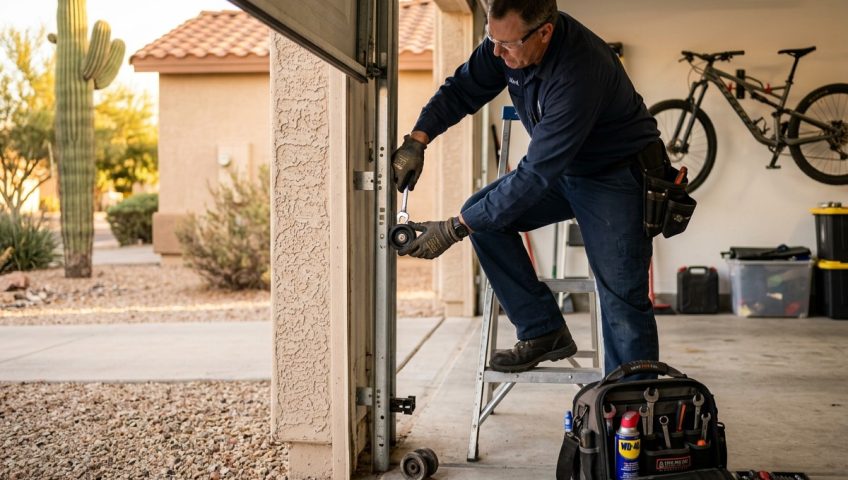
Garage door rollers are one of the most overlooked components in the system — and one of the first to fail under Phoenix heat and daily use. When rollers wear out, the symptoms start subtle: a squeak on the way up, a slight vibration through the door, a grinding sound that wasn’t there six months ago. Left unaddressed, worn rollers transfer their load to the tracks, the hinges, and eventually the opener motor — turning a straightforward roller replacement into a more involved repair.
In Mesa, rollers wear faster than in moderate climates for two reasons. First, garage interiors regularly exceed 130°F in summer, which degrades the nylon and steel components in rollers faster than manufacturers’ rated cycle counts assume. Second, the dust and grit that moves through Mesa garages acts as an abrasive on roller stems and track surfaces, accelerating wear with every cycle. A roller that would last 10–12 years in a cooler, cleaner environment may need replacement in 6–8 years in a Mesa garage running multiple cycles per day.
Our mobile technicians at Discount Garage Door Repair of Mesa are available day and night for roller replacement throughout Mesa and the Metro Phoenix area. Find us on Google Maps to verify our location and read reviews from Mesa homeowners before you call. Roller replacement is one of the most straightforward garage door services we perform — most jobs are completed in under an hour in a single visit.
Over 10 years serving Mesa with transparent pricing. Written quote after inspection, before any work begins. No hidden fees.
How to Tell Your Rollers Need Replacing
Roller wear produces a recognizable pattern of symptoms that gets louder and more disruptive as the component degrades further:
- Grinding or squeaking during operation — the most common early sign. Metal-on-metal contact or a dry roller stem running in the track bracket produces noise that increases over time.
- Vibration through the door panels — worn rollers don’t ride smoothly in the track. The irregular contact transfers vibration into the door itself.
- Door moves unevenly or hesitates — a roller that’s partially seized or has a flat spot from wear causes the door to catch or stutter mid-travel.
- Visible roller damage — cracked nylon wheels, bent stems, or rollers that have jumped the track are visible during a basic inspection above the door.
- Opener working harder than normal — the motor compensates for increased rolling resistance. A door that used to move smoothly now puts more load on the opener motor with every cycle.
- Track scoring or gouging — when roller bearings fail and the steel stem contacts the track directly, it leaves visible scoring on the track interior. Track damage caught early is a track cleaning and new roller job. Caught late, it may require track replacement.
Any combination of these symptoms is the right time to call for an inspection. Rollers don’t self-correct — they get worse with continued use.
Nylon vs. Steel Rollers — What the Difference Means in Mesa
Nylon rollers are the standard for residential garage doors in Mesa. A quality nylon roller runs on sealed ball bearings inside the nylon wheel, which means the bearing handles the load and the nylon provides quiet, smooth contact with the track. Nylon rollers are significantly quieter than steel rollers and don’t require lubrication on the wheel surface. The sealed bearings protect the rolling mechanism from the dust and grit common in Mesa garages. High-cycle nylon rollers — rated for 20,000+ cycles — are available as upgrades over the builder-grade 10,000-cycle rollers installed in most Mesa homes.
Steel rollers are found on older homes and some commercial installations. They’re durable but loud, and they require more frequent lubrication to prevent the metal-on-metal contact that accelerates both roller and track wear. When steel rollers dry out in Mesa’s heat, the noise increase is immediate and significant. If your door was installed before 2000 and has never had rollers replaced, it almost certainly has steel rollers that are due for inspection.
When we replace rollers in Mesa, we use nylon rollers with sealed ball bearings as the standard replacement. If the door has a history of heavy use or the homeowner wants to reduce future maintenance frequency, we carry high-cycle roller options and walk you through the comparison before ordering.
Our roller and cable replacement service covers both components together when applicable — cables and rollers wear on the same timeline and are accessed from the same areas of the door, so replacing both in one visit is the most efficient approach when both are due.
| Symptom | Likely Cause | What a Pro Checks |
|---|---|---|
| Grinding or squeaking during operation | Worn or dry roller bearings | Roller spin, bearing condition, stem wear in bracket |
| Door vibrates through panels | Rollers with flat spots or irregular wear | Full roller set inspection, hinge bracket wear |
| Door catches or stutters mid-travel | Partially seized roller or track debris | Roller rotation, track interior condition, alignment |
| Opener working harder than before | Increased rolling resistance from worn rollers | Door balance test, roller condition, spring tension |
| Visible scoring inside the track | Roller bearing failed, steel stem contacting track | Track interior damage depth, roller bearing condition |
| Cracked or chipped nylon roller wheel | Heat degradation or impact damage | Full roller set condition, hinge bracket integrity |
What Roller Replacement Involves
Replacing garage door rollers requires removing each roller from its hinge bracket, sliding it out of the track, and installing the new roller in reverse sequence. The bottom two rollers — the lowest set on each side — are the exception. They sit in the bottom bracket that also anchors the lift cable. Removing the bottom bracket rollers requires releasing cable tension before the bracket can be safely accessed. This is the step that turns a DIY roller swap into a professional repair — cables under tension are not a component to work around without the right tools and training.
When our technician arrives at your Mesa home, the inspection covers all rollers in sequence from top to bottom, plus hinge condition, track interior surface, and cable condition. Worn hinges that are allowing the roller stem to wobble in the bracket get flagged — a new roller in a worn hinge bracket will wear faster than it should. Track scoring from failed bearings gets noted — light scoring can be smoothed; deep gouging means the track section needs replacement.
After the inspection we provide a written quote for the full scope of work. Most residential roller replacements — full sets of 10–12 rollers depending on door panel count — are completed in 45–60 minutes. If the cables show wear alongside the rollers, we address both in the same visit using our residential garage door repair service. If the track shows damage from extended roller wear, our track repair service covers that in the same call.
Frequently Asked Questions
How long does roller replacement take? +
Can I replace garage door rollers myself? +
Should I replace all rollers at once or just the bad ones? +
How long do new garage door rollers last in Mesa? +
Will new rollers fix my noisy garage door? +
Are you available for same-day roller replacement in Mesa? +
Stop the Noise Before It Becomes a Bigger Repair
A grinding garage door in Mesa isn’t just an inconvenience — it’s a door telling you that its rollers are transferring wear to the tracks, the hinges, and the opener motor on every single cycle. The longer worn rollers run, the more components they affect. Catching it at the roller stage keeps the repair straightforward and the cost predictable.
Discount Garage Door Repair of Mesa has been serving Mesa homeowners for over 10 years with transparent pricing and same-day availability. Our mobile technicians carry nylon roller sets for all standard residential door configurations, and most jobs are finished in under an hour. Located at 1616 E Main St, Suite 207A in Mesa, we’re the local team for garage door repair throughout Mesa and Metro Phoenix.
Call (480) 531-7181 to schedule your roller inspection. Visit our contact page for non-urgent scheduling, or browse our full services menu for everything we cover in Mesa and the surrounding area.