
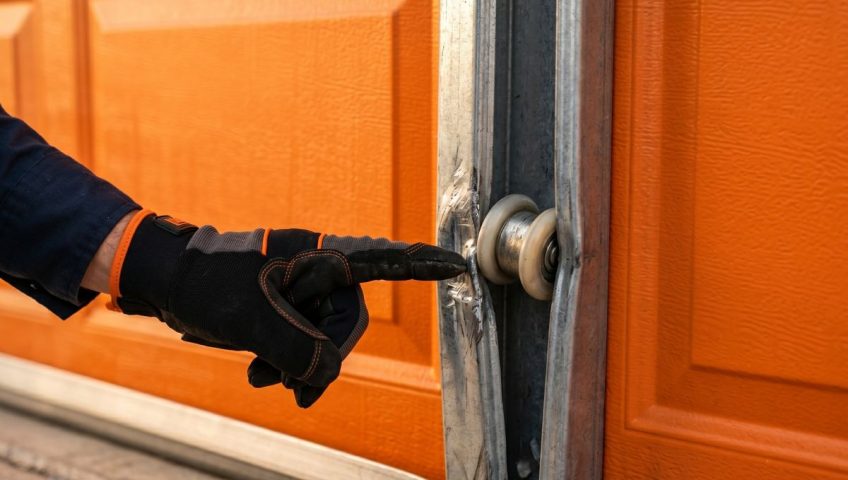
An off-track garage door is one of the most common — and most disruptive — problems Mesa homeowners face. When a door jumps its track, it won’t open or close properly, leaving your vehicle trapped or your home exposed. At Discount Garage Door Repair of Mesa, we’ve handled this issue hundreds of times across the Valley, and in this guide we walk you through what causes it, what you can safely check yourself, and when it’s time to call a trained technician.
Why Garage Doors Come Off Their Tracks
Understanding what puts a garage door off-track in the first place is the foundation of any lasting repair. We see this problem triggered by a handful of recurring culprits, and the fix almost always depends on correctly identifying which one you’re dealing with.
Broken or Worn Rollers
The rollers are the small wheels that ride inside the vertical and horizontal tracks on each side of the door. Over years of daily use — especially in Mesa’s extreme heat, which accelerates rubber and nylon degradation — rollers wear flat, crack, or seize. When a roller fails, the door panel on that side loses its guide and shifts laterally out of the channel. We replace rollers as part of our routine garage door services and almost always recommend doing all rollers at once rather than patching one at a time.
Bent or Damaged Track Sections
Tracks are aluminum or steel channels that run vertically up the wall and curve horizontally along the ceiling. A vehicle bumping the bottom of the track, a heavy impact, or even years of thermal expansion and contraction can bend a section enough that the rollers can no longer pass through cleanly. A dent as shallow as a quarter-inch is enough to derail a heavy steel door panel. Our track adjustment and replacement service addresses both minor realignment and full section replacement.
Broken Torsion or Extension Springs
The springs do the heavy lifting — they counterbalance the door’s weight so the opener only has to apply a small amount of force. When a spring snaps, the door becomes dramatically heavier on one side. The opener pulls anyway, the cables tension unevenly, and the door torques sideways off the track. Garage door spring installation and repair is one of the most technically demanding jobs we perform, and it’s not one we recommend attempting without professional training and the right tools.
Loose or Snapped Cables
Lift cables run from the bottom corners of the door up to the spring drum. A frayed or snapped cable causes the same imbalance problem as a broken spring — one corner drops, the door skews, and the rollers pop out. Cable repairs go hand-in-hand with residential garage door repair and should always be inspected together with the springs.
Misaligned Track Brackets
The brackets that bolt the track to the wall can loosen over time due to vibration. Even a few millimeters of lateral shift in one bracket changes the geometry enough to cause binding or derailment. We retighten and realign brackets as part of every garage door maintenance visit we perform in Mesa and the surrounding metro area.
| Cause of Derailment | Visible Signs | DIY-Safe? | Recommended Action |
|---|---|---|---|
| Worn or broken rollers | Door wobbles, grinds, or scrapes on one side | Partial | Replace all rollers; call a tech for bottom-bracket rollers |
| Bent track section | Visible dent or gap in track; door stops mid-travel | No | Track realignment or section replacement by a technician |
| Broken torsion spring | Loud bang, door extremely heavy, visible gap in spring | No | Professional spring replacement only — high-tension hazard |
| Snapped lift cable | Cable coiled on floor, door lower on one side | No | Cable and spring inspection by a trained technician |
| Loose track bracket | Track visibly pulled away from wall; rattling sound | Partial | Tighten lag bolts; re-check alignment after tightening |
| Impact damage (vehicle strike) | Dented panel, bent bottom bracket, misaligned rollers | No | Full inspection — multiple components likely affected |
| Obstruction in track | Door stops suddenly; debris visible inside channel | Yes | Clear debris, inspect roller for damage before restarting |
| Opener force set too high | Door slams on close, strains on open, rollers pop out repeatedly | Partial | Reduce force settings; inspect opener hardware and springs |
What You Can Safely Inspect Before Calling Us
We always encourage Mesa homeowners to do a basic visual inspection before picking up the phone — not because we want you to attempt the repair yourself, but because the information you gather helps our technicians arrive prepared with the right parts.
Step 1 — Disconnect the Opener
Pull the red emergency release cord hanging from the opener trolley. This disengages the door from the drive mechanism so it can move freely on its own. Never operate an off-track door with the opener engaged — the motor will continue pulling against the derailed panel and can cause cable or opener damage.
Step 2 — Look at the Rollers and Track Gap
With a flashlight, examine each roller from the outside. Look for rollers that have completely left the track channel, cracked wheels, or rollers that are seated but visibly wobbling. Note which side of the door has the problem — left, right, or both.
Step 3 — Check for Obvious Track Damage
Run your eyes along the full length of both vertical tracks. A bent section usually looks like a visible pinch or wave in the metal. If you see a gap between the track bracket and the wall, that’s a loosened mounting point.
Step 4 — Inspect the Springs
Look up at the horizontal bar above the door. Torsion springs run along this bar and are easy to inspect: a broken spring has a visible separation or gap in the coil. Do not touch the spring, cables, or bottom brackets — these are under extreme tension even when the door is down.
Step 5 — Document and Call
Take a photo of the area where the door appears most obviously off-track. This is the single most helpful thing you can do before our garage door repair technicians arrive. We serve Mesa and the entire Metro Phoenix area, and our mobile units carry the most common replacement rollers, cable sets, and track hardware on every call.
How We Repair an Off-Track Garage Door in Mesa
When our technicians respond to an off-track garage door call, we follow a structured diagnostic and repair process that we’ve refined over years of work in the Valley. Here’s what that process looks like from start to finish.
Full-System Inspection First
Before touching any hardware, we assess the entire door system — not just the point of derailment. An off-track door is almost always a symptom rather than a standalone problem. We check spring tension, cable condition, roller wear, track geometry, bracket torque, and opener force settings all at once. This is what separates a proper repair from a patch job.
Roller Reinsertion and Track Realignment
For cases where the track is still straight and the rollers simply jumped out, we manually guide the rollers back into the channel using purpose-built tools that hold the track open just enough without damaging the metal. We then close the gap back to the manufacturer’s specified clearance — typically between 1/4 and 3/8 inch from the door panel edge — and verify smooth travel through the full range of motion.
Track Section Repair or Replacement
Bent track sections cannot simply be hammered back into shape. Deformed metal develops stress fractures that cause repeated failures. We use replacement track sections matched to the door’s weight class and panel width, re-plumb the vertical run with a level, and reset all bracket positions before securing. Our track adjustment and replacement service includes both the hardware and the alignment verification.
Spring and Cable Restoration
If a spring or cable caused the derailment, we address it as part of the same visit. We size replacement torsion springs to the door’s exact weight and height, using industry-standard DASMA specifications. Cables are replaced in pairs to maintain equal tension on both sides. After reinstalling springs and cables, we manually cycle the door several times to confirm balance before reconnecting the opener.
Opener Force Calibration
The final step is always testing the opener’s force and travel limits. An opener set too forcefully will re-derail a correctly aligned door over time. We use the opener’s built-in diagnostics to set force just above the door’s balanced operating load, then verify that the auto-reverse safety feature activates at the correct resistance — a critical garage door safety sensor check we perform on every single call.
When a DIY Attempt Makes Things Worse
We respect that Mesa homeowners are resourceful, and there are a handful of minor tasks — like clearing debris from a track or tightening a loose bracket — that are genuinely within reach of a handy homeowner. But we see a specific pattern of escalated damage from DIY attempts on off-track doors that we want to help you avoid.
Using a pry bar on the track is the most common mistake. Forcing a bent track section wider with a pry bar typically creates a second bend and can snap the bracket welds. What was a $150 track repair becomes a $350 full-side replacement.
Forcing the door closed manually when a roller is out tears the cable off the drum and can strip the cable anchor at the bottom bracket — turning a roller replacement into a full cable-and-drum job.
Reconnecting the opener before fixing the derailment is dangerous. The motor applies 20–50 lbs of force to an already compromised panel, which can cause the door to collapse laterally, bending multiple panels and damaging the opener trolley.
If you’re ever unsure whether a fix is within your skill level, the safest option is always to leave the door in place — disconnected from the opener — and call our commercial or residential team for a same-visit diagnosis. Our technicians have handled every variation of this problem and can tell you within minutes what the correct repair path is.
Preventing Off-Track Problems in Mesa’s Climate
Mesa’s desert climate creates specific stress patterns on garage door hardware that differ from what you’d find in cooler or more humid regions. Summer temperatures routinely push metal tracks and brackets through significant thermal expansion cycles. Here’s what we recommend to Mesa homeowners based on what we observe during maintenance calls.
Lubricate rollers and hinges every six months. Use a silicone-based or white lithium spray — not WD-40, which strips existing lubrication and attracts dust. Apply to rollers, hinge pivot points, and the torsion spring bar. Avoid spraying the track itself.
Inspect and tighten all visible lag bolts annually. The bolts securing track brackets to the wall work loose from vibration. A 3/8-inch socket and a few minutes once a year prevents the most common cause of gradual track drift.
Check roller condition every two years. Standard nylon rollers have a service life of 10,000–15,000 cycles. In a household that opens and closes the door four times daily, that’s roughly seven to ten years — but heat accelerates wear. If your rollers are more than eight years old and you haven’t had them inspected, schedule a maintenance visit through our garage door services page.
Schedule a professional tune-up after any vehicle impact. Even a slow-speed tap against the bottom track section transmits force upward through the entire vertical run. What looks like an undamaged track after a minor collision often has a hairline bend that causes derailment weeks or months later during normal operation.
A yearly preventive maintenance visit from Discount Garage Door Repair of Mesa catches these issues before they become emergency calls. Our technicians document the condition of every component so you have a clear picture of what’s working well and what needs attention in the coming season.
Frequently Asked Questions — Off-Track Garage Door Repair in Mesa, AZ
Is it safe to use a garage door that has come off its track?
No. An off-track door is structurally unstable and can drop or shift suddenly, posing a serious injury risk to anyone nearby. Disconnect the opener using the emergency release cord, leave the door in whatever position it’s currently in, and call a technician before attempting to use the door again.
Can I put a garage door back on track myself?
In some cases — such as a single roller that has popped out of a straight, undamaged track — a careful homeowner can reseat it. However, if the derailment was caused by a broken spring, snapped cable, bent track, or impact damage, a DIY attempt often leads to further damage or injury. We strongly recommend having a trained technician assess the root cause before any repair is attempted.
How long does an off-track garage door repair take?
Most off-track repairs are completed in one to two hours. If the cause is a broken spring, damaged cable, or a bent track section requiring a replacement part, the visit may run slightly longer. Our mobile technicians carry the most common hardware on every truck to minimize delays.
What does it cost to repair an off-track garage door in Mesa?
Cost depends on the root cause. A simple roller reinsertion and track alignment is one of the more affordable garage door repairs. Replacing a broken spring, cable, or a full track section adds to the total. We provide transparent, upfront pricing before any work begins — no surprise charges after the job is done.
How do I know if my garage door track is bent or just misaligned?
A misaligned track typically shows as a visible gap between the track and the door panel edge — usually wider on one side than the other. A bent track shows as a visible wave, dent, or crimp in the metal channel itself. Misalignment can sometimes be corrected by loosening and repositioning the bracket; a bent section almost always requires replacement to prevent repeat derailments.
Does Discount Garage Door Repair serve areas outside Mesa?
Yes. While we are based in Mesa, AZ, our mobile technicians serve the entire Metro Phoenix area including Gilbert, Chandler, Tempe, Scottsdale, and surrounding communities. Call (480) 531-7181 to confirm availability in your specific area.
Trust Discount Garage Door Repair of Mesa With Your Off-Track Door
An off-track garage door is not a problem that improves on its own. Left unrepaired, the structural imbalance puts added stress on the opener motor, accelerates roller and hinge wear, and increases the risk of a panel collapse — particularly on heavier steel and insulated doors common in Mesa-area homes.
At Discount Garage Door Repair of Mesa, our technicians have spent years working specifically on the types of doors found across Maricopa County — from the standard two-car panels in Dobson Ranch to the oversized commercial roll-ups in the Mesa industrial corridor near Falcon Field. We carry that local knowledge into every service call: we know which hardware brands are most common in this market, which failure modes are seasonal, and how to get the job done right the first time.
We invite you to read our related article on garage door spring repair if you suspect a broken spring contributed to your derailment — it covers the warning signs and explains exactly what the replacement process involves.
If your garage door is off-track right now and you need a technician in Mesa or anywhere in Metro Phoenix, don’t wait. Disconnect your opener, keep the area clear, and give us a call. Our mobile team is available for same-day service, and we arrive with the parts and tools to handle the most common causes of derailment in a single visit.
📞 Call Discount Garage Door Repair of Mesa now at (480) 531-7181 — or find us on the map and see why Mesa homeowners trust us with their garage door repairs. Your door should open the way it was designed to. We make sure it does.