
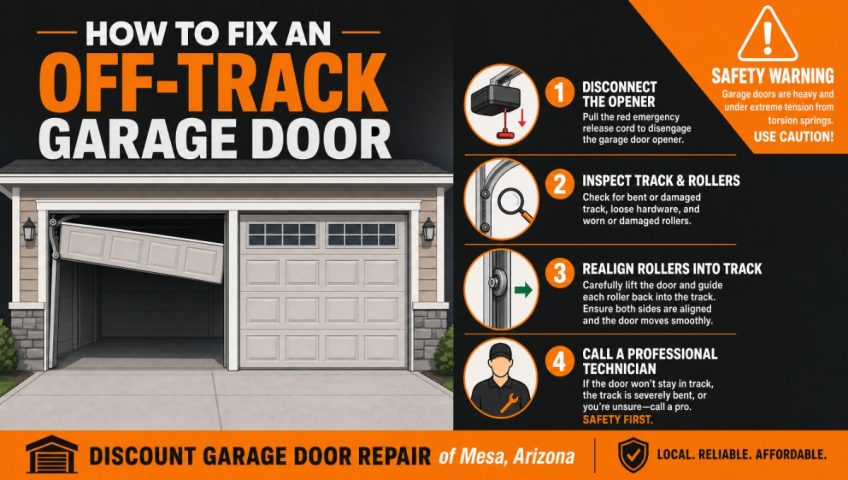
That sudden grinding noise, the panel hanging at an angle, the door frozen halfway up the opening — an off-track garage door turns an everyday convenience into a security risk and a safety hazard in seconds. The good news is that the cause is almost always identifiable, and many situations can be stabilized quickly while a lasting fix is arranged. Below, our team walks you through exactly why doors jump their tracks, what you can safely check yourself, and the moment professional help becomes non-negotiable. Keep reading and you will know precisely what to do next.
We are Discount Garage Door Repair of Mesa Arizona, and over our years serving Valley homeowners we have realigned, rebuilt, and replaced thousands of residential doors. We have written this guide the way we would explain it standing in your driveway: clearly, honestly, and with your safety first.
Why an Off-Track Garage Door Happens (and What It Means for Your Home)
An off-track garage door occurs when one or more rollers slip out of the vertical or horizontal metal tracks that guide the door’s travel. Once a roller leaves its channel, the door’s weight — often 150 pounds or more — becomes unevenly distributed, which is why the panel sags, twists, or jams. Understanding the root cause matters, because a door that derailed from a worn roller needs a very different repair than one knocked loose by a vehicle bumper.
In our experience across Mesa neighborhoods, the most common triggers fall into a handful of categories:
- Broken or worn rollers: Nylon and steel rollers wear out, seize, or shatter, allowing the door to drift out of alignment.
- Bent or damaged tracks: A minor impact, a loose lag bolt, or years of vibration can warp the track just enough for a roller to escape.
- Vehicle or object impact: A bump from a car bumper or a stored item is one of the most frequent causes we see on service calls.
- Loose or failed hardware: Brackets, hinges, and fasteners loosen over time, especially under Arizona’s heat-and-cool daily cycle.
- Broken cables or spring issues: When a lift cable snaps or a torsion spring fails, the door can drop and pull rollers out of the track instantly.
- Dirty or obstructed tracks: Dust, debris, and dried grime build up in the channel and force rollers off course.
Whatever the trigger, a derailed door is more than an inconvenience. It compromises home security, undermines your curb appeal, and — most importantly — puts anyone standing nearby at risk if the panel shifts unexpectedly. If you are unsure what you are dealing with, our Mesa garage door specialists are a phone call away.
Quick Diagnosis: What’s Wrong and What to Do
| Warning Sign | Likely Cause | DIY-Friendly? | Recommended Action |
|---|---|---|---|
| Door hangs crooked, one side lower | Roller out of track or bent track | Sometimes | Stop using the opener; inspect rollers |
| Loud bang, then door dropped | Broken torsion spring or cable | No | Call a professional immediately |
| Grinding or scraping while moving | Worn rollers or dry track | Yes | Clean and lubricate; replace rollers |
| Door stuck partway, won’t move | Roller jammed off-track | Caution | Disconnect opener; do not force it |
| Visible gap between door and wall | Track pulled from frame | No | Schedule professional realignment |
| Door reverses or won’t seal | Misalignment or sensor fault | Sometimes | Check sensors; inspect track |
| Frayed or hanging cable | Cable wear or drum slippage | No | Stop use; call a technician |
| Door jumps at the same spot | Dented track section | Caution | Inspect and reshape or replace track |
How to Fix an Off-Track Garage Door: Step by Step
Before touching anything, set expectations honestly: realigning a roller is sometimes a manageable task, but anything involving springs, cables, or a door under tension belongs to a trained technician. With that boundary clear, here is the process our installers follow, adapted for a homeowner’s safe first response.
Step 1 — Stop and Disconnect the Opener
Never operate the motor on a derailed door; forcing it can bend the track, snap a cable, or damage the opener itself. Pull the red emergency release cord so the door is in manual mode. This single step prevents the majority of secondary damage we are called to repair. If you are unsure how your unit disengages, our support team in Mesa can talk you through it.
Step 2 — Inspect the Track and Rollers
With the opener disengaged, look closely at where the roller left the track. Check for a bent rail, a flattened section, or a roller that is cracked or seized. A flashlight and a few minutes of careful observation tell you most of what you need to know. Note which side is affected and whether the damage looks like a clean derail or a deformed track — that distinction guides every garage door repair in Mesa we perform.
Step 3 — Secure the Door
If the door is partially open, use locking pliers clamped to the track below a roller, or have a second person steady the panel. A door that is off balance can move on its own. This is the point where many homeowners wisely decide to call us instead of going further, and we always respect that judgment.
Step 4 — Realign the Roller (Light Cases Only)
For a simple derail with no spring or cable involvement, you can sometimes open the track lip slightly with pliers, guide the roller back into the channel, and gently tap the track back into shape. Then re-seat the roller and confirm smooth movement by hand before reconnecting power. If the roller resists, the track is bent, or the door feels heavy or jerky, stop — this has crossed into professional territory, and our Mesa technicians are equipped to finish it correctly.
Step 5 — Test, Lubricate, and Reconnect
Once the roller is seated, lift and lower the door manually two or three times. It should glide without binding. Apply a garage-door-rated lubricant to rollers, hinges, and the track, then reconnect the opener and run one full cycle while watching closely. If anything looks off, disconnect again and reach out to our repair team.
⚠️ Safety Warning: Read Before You Touch the Springs
A garage door’s torsion springs and cables store enormous mechanical energy — enough to cause serious injury or worse if they release suddenly. Never attempt to loosen, adjust, or remove a spring, cable, or bottom bracket yourself. The same caution applies to the electrical components of your opener. If your off-track garage door involves a broken spring, a snapped cable, or any tension-loaded part, stop immediately and call a trained professional. No repair is worth a trip to the emergency room.
Off-Track Garage Door: DIY vs. Professional Repair
Homeowners often ask whether they should attempt the fix or call us. The honest answer depends on the cause and your comfort level. A roller that slipped out cleanly is reasonable to tackle; a spring, cable, or bent-track problem is not. We believe in transparency, so here is how we frame the decision for our customers, and you can always confirm with our Mesa service team.
- Choose DIY when: the door is fully down and balanced, a single roller has clearly derailed, no spring or cable is involved, and you have the right tools and a helper.
- Choose a professional when: a spring or cable is broken, the track is bent, the door is stuck under tension, multiple rollers are off, or you simply want it done safely the first time.
Our trucks arrive stocked with rollers, tracks, hinges, cables, and springs compatible with the major brands homeowners rely on — including LiftMaster, Chamberlain, and Genie openers — so most repairs are completed in a single visit. When you book through our Mesa garage door company, you also get a technician who inspects the whole system, not just the obvious symptom.
How We Repair Off-Track Doors the Right Way
What separates a lasting repair from a temporary patch is method and experience. Every technician on our team is trained on residential and commercial systems, follows established safety standards, and works to the manufacturer specifications for the hardware on your home. When we respond to an off-track garage door call across Mesa and the East Valley, we follow a consistent protocol.
A Full-System Inspection, Not a Quick Patch
We start by examining tracks, rollers, hinges, cables, springs, and the opener as one connected system. A door rarely jumps the track for a single isolated reason, and addressing only the visible symptom is how repeat failures happen. Our inspection process in Mesa is designed to catch the secondary wear that caused the derail in the first place.
Correct Parts, Correctly Installed
We match replacement rollers, tracks, and springs to the door’s weight and cycle rating rather than installing whatever is cheapest. Using the right components is the difference between a door that lasts years and one that fails again within months. Customers across the Valley trust our team precisely because we do not cut corners.
Balance, Testing, and Smart-Home Readiness
After realigning and replacing parts, we re-balance the door, fine-tune the opener’s travel and force settings, and confirm the safety sensors reverse correctly. For homeowners upgrading their setup, we can also advise on smart home integration so your door works with modern app-based and voice controls. Every repair ends with a hands-on test, and we will gladly explain what we found — transparency is a cornerstone of how our Mesa garage door experts operate. You can reach us anytime through our contact page or by visiting our Google Business listing for Mesa.
Preventing Your Garage Door From Going Off-Track Again
The best repair is the one you never need. A little routine care keeps rollers in their channels and protects both your home security and your curb appeal. We share these maintenance habits with every customer, and our Mesa maintenance team can handle them for you on an annual visit.
- Lubricate moving parts every few months with a garage-door-rated product — never heavy grease that traps dust.
- Keep tracks clean and free of debris, especially during dusty Arizona wind season.
- Tighten hardware — check brackets, bolts, and hinges twice a year as heat cycles loosen them.
- Listen for changes — grinding, popping, or hesitation is an early warning worth a quick professional look.
- Schedule an annual tune-up so a technician can spot worn rollers and fraying cables before they cause a derail.
Preventive care costs a fraction of an emergency repair and extends the life of the entire system. If it has been more than a year since your door was serviced, our Mesa team is ready to help.
Frequently Asked Questions About Off-Track Garage Doors
Is it safe to fix an off-track garage door myself?
A simple, fully-lowered door with one cleanly derailed roller and no spring or cable damage can sometimes be handled carefully. Anything involving torsion springs, cables, or a door stuck under tension should always be left to a trained professional for your safety.
How much does it cost to repair an off-track garage door?
Cost depends on the cause — a single roller realignment is far less involved than replacing a bent track, cables, or springs. We provide a clear, upfront estimate before any work begins so there are no surprises. Contact our Mesa team for a transparent quote.
Why does my garage door keep coming off the track?
Repeated derailing usually points to an underlying issue: worn rollers, a slightly bent track, loose hardware, or failing cables. A one-time realignment that ignores the root cause will not hold. A full-system inspection identifies and corrects the real problem.
Can I still use my garage door if it is off-track?
No. Operating a derailed door can bend the track, snap a cable, damage the opener, and create a serious safety hazard. Disconnect the opener with the emergency release cord and avoid using it until it is repaired.
How long does a professional off-track repair take?
Most straightforward off-track repairs are completed in a single visit, often within an hour or two. Our trucks carry common rollers, tracks, hinges, cables, and springs for major brands so we can finish the job the same day in most cases.
Do you service all garage door opener brands in Mesa?
Yes. We work with the major brands homeowners rely on, including LiftMaster, Chamberlain, and Genie, and we can also advise on smart home integration. Reach out to our Mesa team and we will match the right solution to your system.
Keep Your Mesa Home Secure With a Door That Runs On-Track
A derailed door is rarely just a mechanical hiccup — it is a signal that part of the system needs attention before a small problem becomes a costly one. Whether you safely re-seated a single roller or you are facing a broken spring you should never touch, knowing the line between a quick fix and a professional off-track garage door repair protects your family, your property, and your peace of mind. If you found this helpful, our guide on extending the life of your garage door springs is a natural next read.
When you are ready for hands-on help, the team at Discount Garage Door Repair of Mesa Arizona is here with the experience, training, and honest pricing Valley homeowners count on. Call us today to schedule a professional inspection or same-day repair, and let us get your door running smoothly and safely again. You can also find directions, hours, and reviews on our Google Maps location in Mesa, Arizona — stop by, leave a review, or simply confirm we are right around the corner. Your safe, secure, great-looking garage door is one call away.